How Is Intergenerational Trauma Used in Maus by Art Spiegelman
Mountains of Trauma: Maus & The Retentivity of the Holocaust
(TW: Graphic images, subject matter)
The stain of the Holocaust on man history bleeds deep in the psyche of historians, survivors, and the children of those who made it through alive. In that location is no shortage of literature reflecting on and detailing the tragedies; there are vast collections of stories and memoirs written in the aftermath. Art Spiegelman, a Nobel laureate and '2nd-generation' Holocaust victim, drafted Maus in an endeavour to reconcile the trauma he inherited. Spiegelman copes with that heritage through art, specifically drawings in Maus, a graphic narrative retelling his father'due south memory of his experience in Auschwitz. Photography, another medium of fine art, was used during the Holocaust too, and photographs juxtapose the function of drawings to reveal only how difficult it is to capture memory and mountains of trauma.
The unique angle that Spiegelman provides in his work is that of a Holocaust survivor's child. The transmission of Holocaust trauma is a phenomenon that psychologists have witnessed for decades following Earth War Ii. The children of imprisoned persons, especially Jewish persons, are observed exhibiting similar/the aforementioned psychological responses that their parents exhibited. Trauma is passed on, and memory is perpetuated in stories, drawings, and photographs.
Artie provides this perspective of inherited trauma to the canon of Holocaust literature, and the medium of comics creates even more angles to explore memory and emotion.
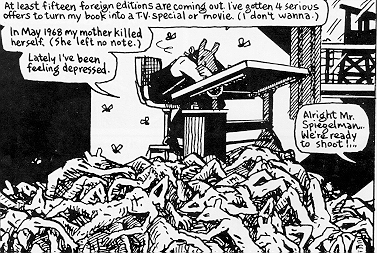
The in a higher place panel, taken from the showtime page of the time flies episode in Maus II, summarizes accurately the lamentable state of affairs in which Spiegelman resides for the entirety of Maus' structure.
In this paradigm, Artie is wearing a mouse mask while sitting at his drawing tabular array. There is a large pile of dead mouse bodies surrounding him on the flooring, and flies circle above the bodies. Through the window a watchtower can be seen, lurking exterior above the corners of the camp. In the cartoon of Maus, Artie has transported himself mentally and visually into Auschwitz. The panel itself occupies half of the folio, and its sheer volume invokes the mountainous volume of trauma that Artie must reconcile with. The employ of shadow and highlight directs the eye to the human being behind the mask, sitting at the tabular array. Spiegelman fabricated a mountain of bodies strewn about carelessly every bit they would accept been treated in the army camp. In Maus, Artie reports of doing research near the camp where his parents were, and the prototype conjugated here is one that might come to mind for many. Graphic, emotional, silencing images of bodies like this circulated post-liberation, only it is juxtaposed with the method of comics, which are usually lighthearted in nature.
Spiegelman uses the text boxes to jump dorsum and along with the past and present, representing Artie's train of thought in regards to his own memories and knowledge. In the other panels that share the page, Artie is thinking in the aforementioned pattern — juxtaposition of present events and past — as shown here:

This collision of present and by is the essence of memory; memories are past experiences re-contextualized in the nowadays. Spiegelman's utilize of a text box as opposed to a caption box ascribes these memories and thoughts to Artie himself. Even though he never saw the pile of bodies or the watchtower, his reality in this console is cathartic. He is transported into his father'southward memories, a heritage that he did not choose but must reconcile. The vehicle for this transportation is comics. Spiegelman never witnessed Auschwitz himself, and so drawing is the tool used to pay witness to his father'due south memories.
Past drawing attention to the very creation of Maus, Spiegelman demonstrates the unrelenting persistence of the Holocaust even across generations. He also shows how memory is especially powerful; images are burned into the mind. The utilize of comics every bit a medium works in tandem with the power of retentivity. Memory is not confined to paragraphs; it is besides the non-linear weaving of images and dialogue. In the case of Vladek'due south memories, the subject matter is extremely graphic and emotionally distressing. Artie is enlightened of this fact and his anxieties are shown in his posture on the page. What he aims to represent is a glimpse of the most horrible event in human history, and he uses a medium known for lightheartedness. Earlier in Maus Two, Artie exclaims:
"It's so presumptuous of me…How am I supposed to make whatever sense out of Auschwitz?…Of the Holocaust?" (Spiegelman 14).
Making sense of the Holocaust has proved an impossible task thus far in human history, and it may not need to exist achieved. Artie's work functions not to solve all the issues that the Holocaust raises, only to reconcile with the trauma that was left in its wake.
Towards the cease of World War II, Allied troops moved across Europe. As these troops discovered and liberated concentration camps — as Vladek remembers in Maus — photographs were taken. A principal reason for taking such images was due to the reports of war crimes committed by Germany. Documentation would be necessary for inevitable legal proceedings. The post-obit is a graphic image taken probable by an Allied soldier.

The focal point of this image is the morose mountain that the Nazi directors of the campsite left backside. The bodies are piled inhumanely, carelessly, and abased to the decay of time while the directors fled. While this epitome was not taken from the Auschwitz-Birkenau liberation, it expresses the aforementioned deep, unavoidable human being trauma that perpetuated long afterward World War II. This widespread wound is echoed in the children of Holocaust survivors, and shared, although in reduced concentrations, with the rest of the world.
While the latter of these images is a 'real,' direct image taken at a concentration camp, the first serves as an echo of the retention of the latter. While Art Spiegelman never witnessed this pile of bodies, in his drafting of the paradigm — and Maus itself — is subject to the horrors that his father Vladek witnessed immediate. Such is the value of the 2 different mediums: they demonstrate the difference betwixt Vladek's memory and Fine art'south understanding of the story. A photograph is an epitome captured in a moment; it is nowadays tense. The few soldiers who had camera access during WWII liberation took photographs of what they saw, only most of the circulated photos followed the styles of war photography and general photojournalism. The image at hand certainly is not utilizing very many complex techniques and merely takes express liberties in terms of camera angle, exposure, framing, motion, and other qualities. The photograph is stark; the technology of the time limited the colors to grey calibration.
While the focal point of this image is eerily similar to that of Maus' image, the purpose of this photograph is entirely dissimilar. The photograph was taken as a way to document accurately the scene at hand. While the soldiers are indeed forced to confront the trauma, their job was to assess and document the state of affairs from a 3rd-party point of view. The photo confronts the viewer with the reality of what the Nazi regime truly did. There is no personal investment in this image; capturing this moment was a task assigned to them.Therefore, the aesthetic choices in this prototype are not essential to the understanding of the image. In the liberation-photography medium, the function was documentation, not personal reconciliation. The personal narratives of the Holocaust belong not to these soldiers, but to the victims, and this photograph recognizes that it was not their story to tell. The photograph depicts the soldiers' perspective of the backwash.
Drawings, on the other hand, specially in the course of a graphic novel, are reverberations of memories. In the case of Maus, Artie's drawings are of memories that he himself did non experience, but that were handed down through story. This inheritance is reconciled on the page.
The smells, temperature, textures, sounds, and colors are markedly absent from this medium. The photographs presented above likewise fall brusque; the engineering science at the time express the lensman to blackness and white images. In hindsight, this lacking of details might be criticized past people at present and discouraging in the attempt to sympathise Holocaust experiences. However, fine art is equally close as the living may get. Art Spiegelman was non nowadays, either, and his work does not pretend that he was there. His work simply embodies the retelling of his father'south experience.
Art Spiegelman willingly experiences secondhand the most big-scale, horrendous event in human being history through the concrete representation of his begetter'due south retention. His fine art is a coping mechanism for the psychological scars. Through the memories of an individual, Artie takes on the mount of grief accompanied with the unabridged issue, the same mountain drawn on page 41 of Maus Ii. He is forced to reconcile with the trauma, and does so through fine art.
Bystanders of the memories, the spectators of the by, the inheritors of trauma: we have the position of interpretation. The non-survivors and non-soldiers of this event are put in the part of interpreting what is left behind. It is extremely difficult to capture memory in drawing, photograph, or prose. In the example of Maus, Artie captures a retention that does non fifty-fifty vest to him. The soldiers too probable experienced difficultly capturing the photograph of the innocent slaughtered, knowing they were also late for intervention.
The drawing gives a true film of Vladek's retentivity, but the photograph shows a more than simplified of the 'actual' reality. These two images are not in opposition to each other; they work in tandem, stitching together a narrative for the audience, for Artie, and for all who were not immediate witnesses. The inherited, mountainous trauma must be reconciled.
___________________________________________________________________
Written for a Due north Carolina Land Academy literary course in Fall 2015, under the didactics of James Mulholland
Source: https://medium.com/@rlgamelin/mountains-of-trauma-maus-the-memory-of-the-holocaust-51912ba34aee
0 Response to "How Is Intergenerational Trauma Used in Maus by Art Spiegelman"
Post a Comment