Platoon Takes Picture With Baby of Fallen Comrad
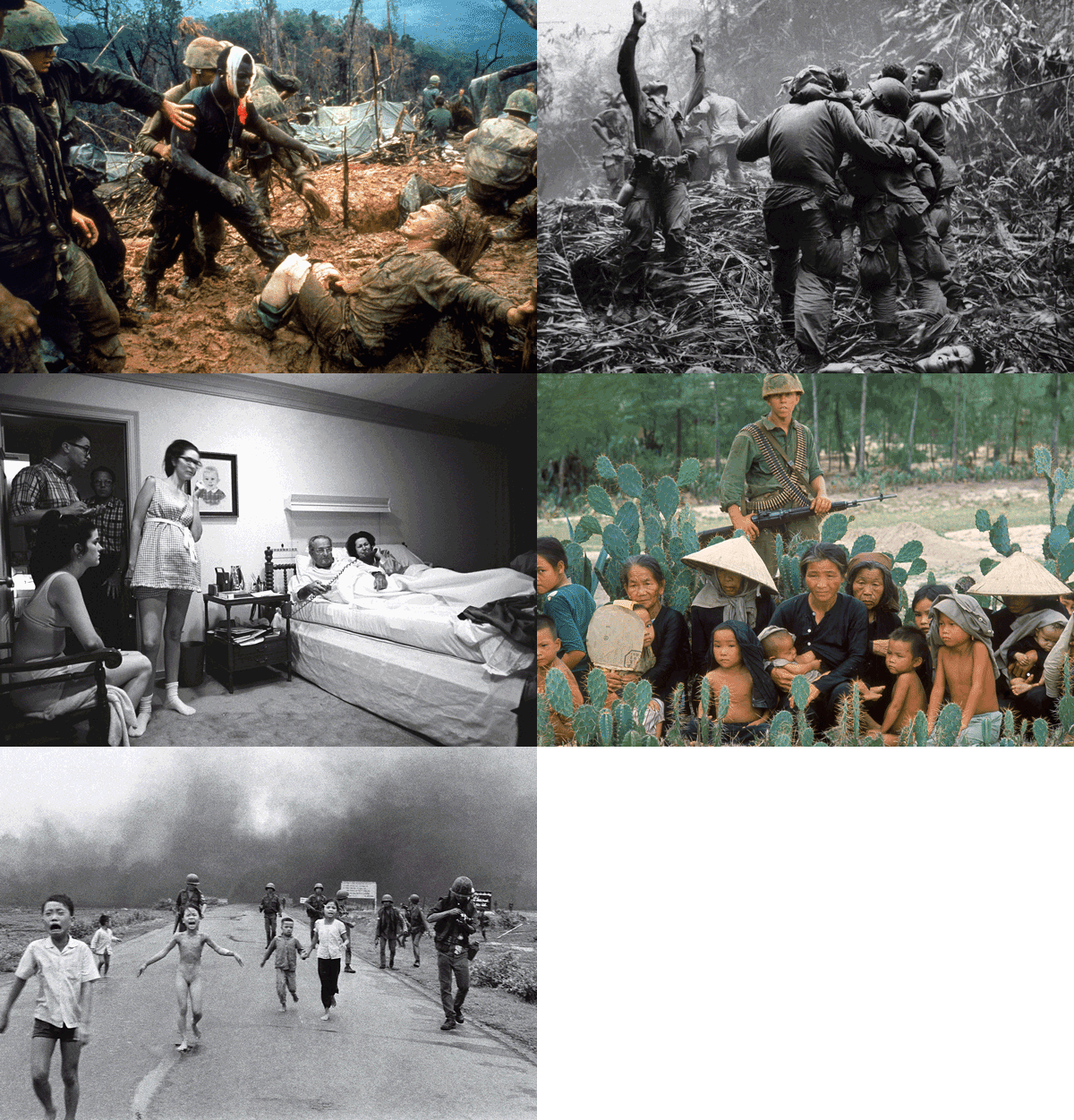
'Who is the Enemy Hither?'
The vietnam war Pictures That Moved Them Most
While the Vietnam War raged — roughly two decades' worth of bloody and world-changing years — compelling images fabricated their way out of the gainsay zones. On idiot box screens and magazine pages around the world, photographs told a story of a fight that only got more confusing, more devastating, as it went on. As Jon Meacham describes in this calendar week's issue of TIME, the pictures from that period can help illuminate the "demons" of Vietnam.
And, in the decades since, the most striking of those images take retained their power. Think of the War in Vietnam and the epitome in your mind is likely one that was first captured on pic, and then in the public imagination. How those photographs made history is underscored throughout the new documentary serial The Vietnam War, from Ken Burns and Lynn Novick. The serial features a broad range of war images, both famous and forgotten.
Merely few people take a amend grasp on the role of photography in Vietnam than the photographers themselves, and those who lived and worked alongside them. With the state of war one time over again making headlines, TIME asked a number of those individuals to select an image from the period that they found particularly significant, and to explicate why that photograph moved them the nearly.
Here, lightly edited, are their responses.
—Lily Rothman and Alice Gabriner
Don McCullin
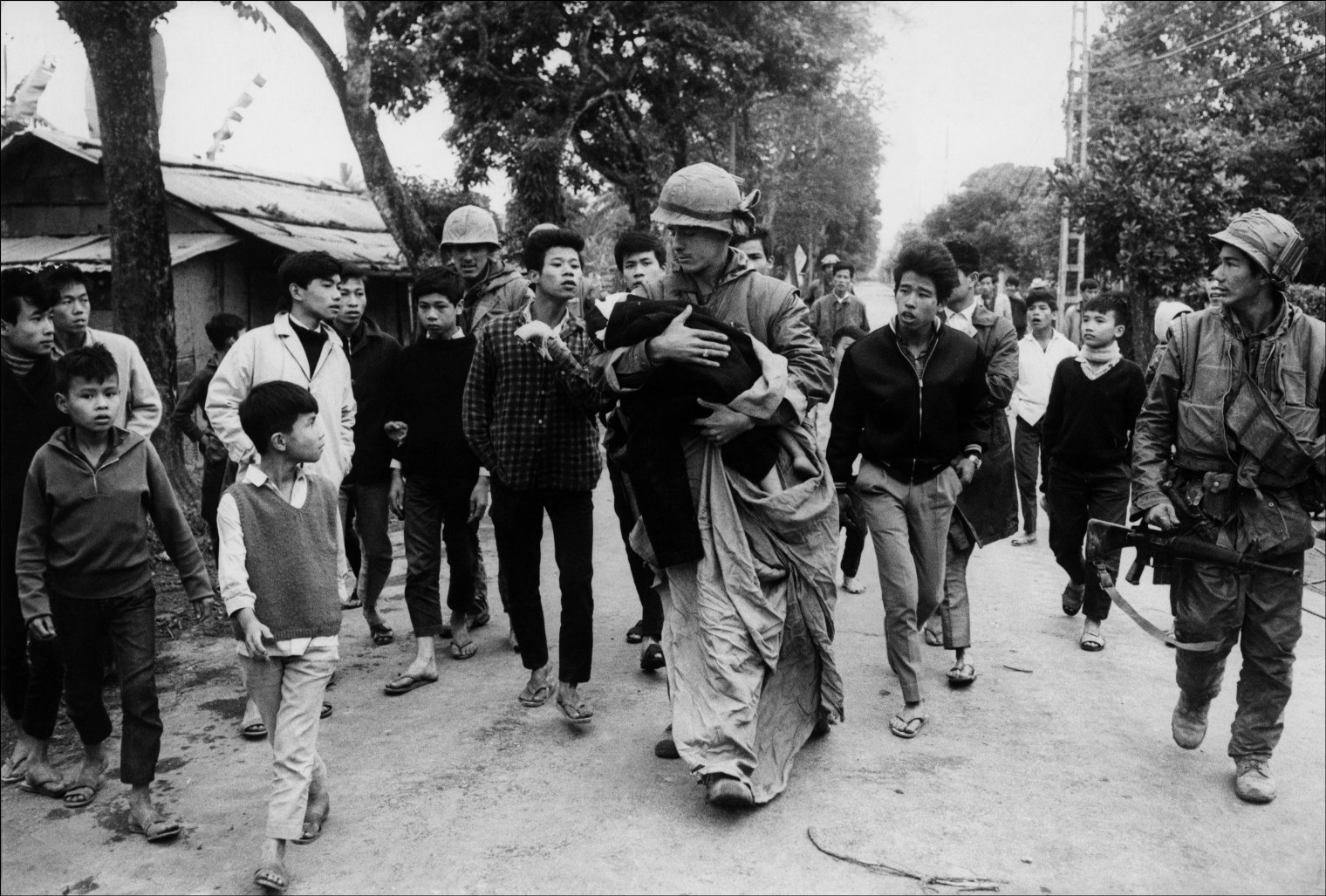
Don McCullin— Contact Press Images
My picture of the U.S. corpsman carrying an injured kid away from the battle in Hué is a rare occasion to evidence the true value of homo kindness and the dignity of man. The child was plant wandering the previous night between the North Vietnamese and the American firing lines. His parents had probably been killed.
They took the child into a bunker, cleaned him up and dressed his wounds nether candlelight. These difficult Marines suddenly became the most gentle, loving persons. It was almost a religious feel for me to tape this extraordinary consequence.
The following forenoon, this corpsman took the kid to the rear of the battle zone where he could be handed over for more than medical attention. He carried the kid as if information technology were his own, wrapped into a poncho, because it was quite cold. A naked limb is hanging from the poncho. Looking dorsum today on this picture I took so long ago I can see that at that place is an repeat here of the famous Robert Capa image of the adult female whose head had been shaved at the end of WWII because she was considered to be a Nazi collaborator and had a child — whom she hugs to her breast — with a German soldier. I didn't recollect of Capa when I pressed the shutter, but I believe both images share an emotional impact because they involve children. Though Capa's illustrates cruelty, my corpsman illustrates humanity, well-nigh saintliness — a homo carrying a kid abroad from the sorrow and injuries of state of war.
Howard Sochurek
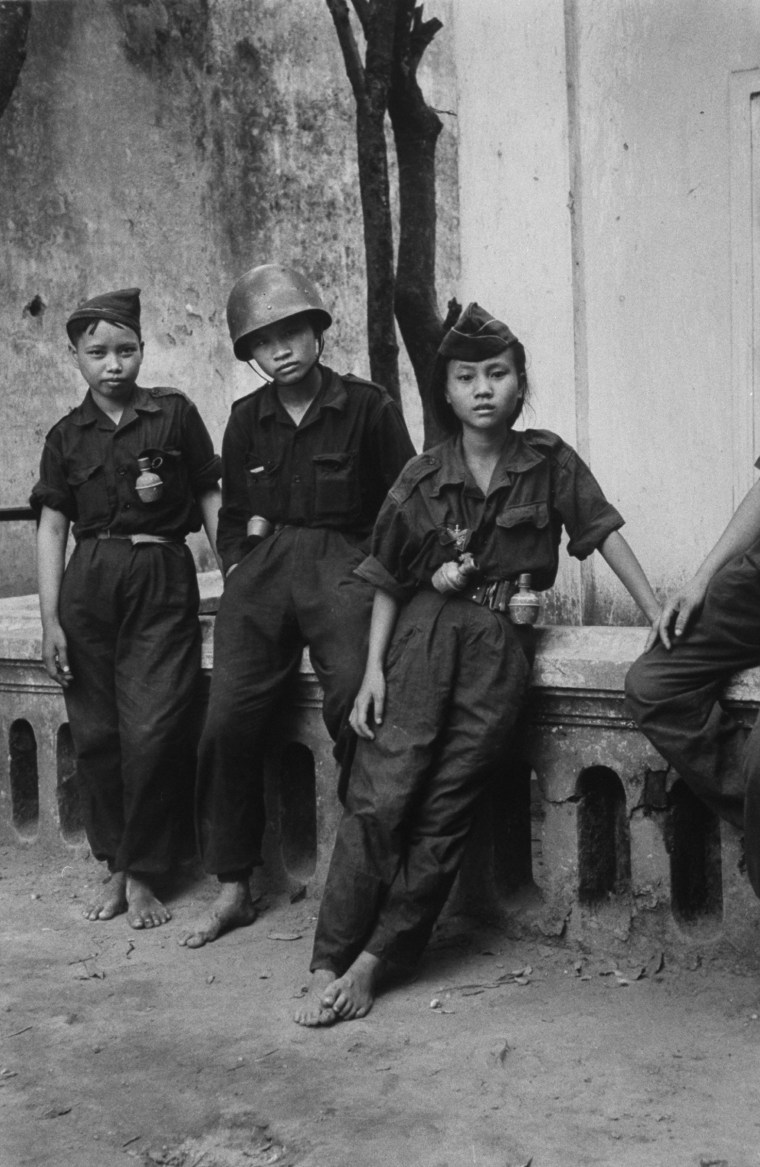 Young guerrillas wear grenades at their belts, preparing to fight the encroaching Viet Minh forces in the Ruddy River Delta, northern Vietnam, 1954. Howard Sochurek—The LIFE Picture Collection
Tania Sochurek, widow of photographer Howard Sochurek:
The conflict in Vietnam spanned almost 20 years. Howard was a staff photographer for LIFE in the early 1950s, when he was first assigned to encompass the fighting in what was then Indochina. He was there on the ground for the brutal — and historic — fall of Dien Bien Phu that marked the cease of the French involvement in the region.
It's insane to think that these iii young children with grenades were going off to fight the Viet Minh army. Sadly, they probably died quickly in the war. This is a photo that Howard felt was very powerful.
In 1954, Howard was again on consignment in Vietnam when he was called home to Milwaukee to be with his mother, who was terminally ill. The acclaimed photographer Robert Capa came in to take his place and cover the fighting. A brusk time after, Capa was killed by a land mine while out on a mission with the U.S. troops. Over the years, Howard would often tell this story and recall sadly that Capa had died covering his assignment. He was immensely proud to receive the Robert Capa Aureate Medal Award for "top photography requiring exceptional courage and enterprise abroad" from the Overseas Press Club in 1955.
Gilles Caron
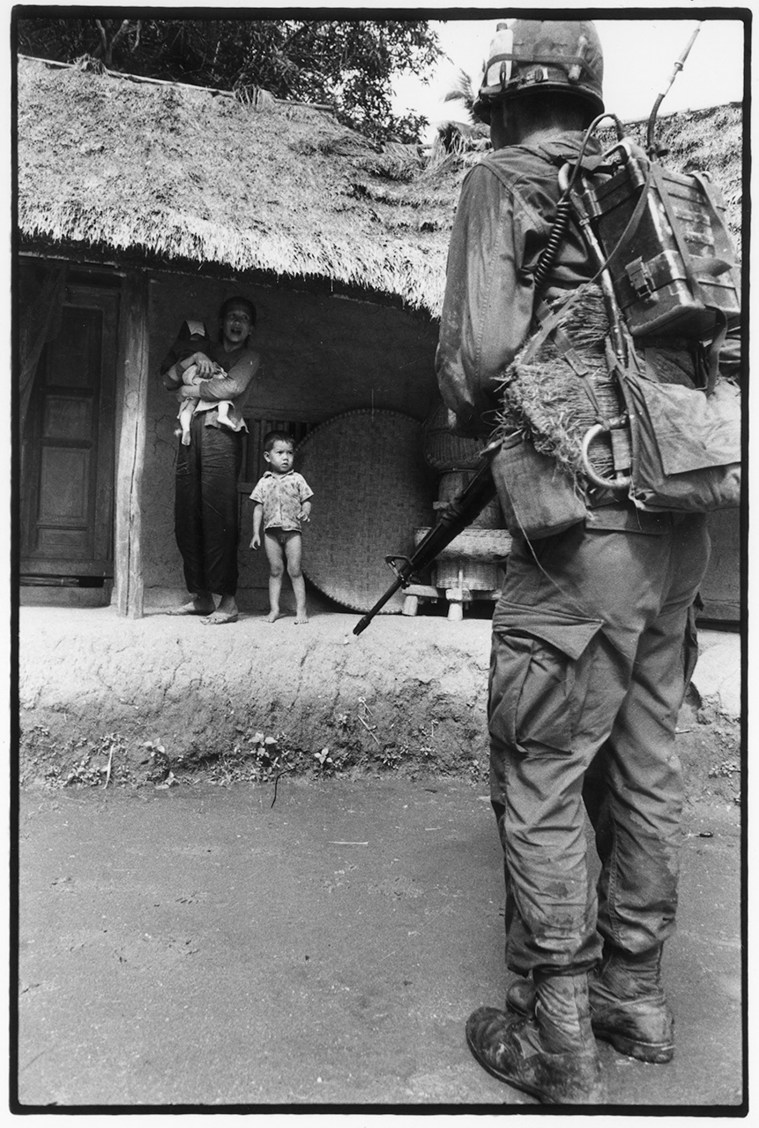 Gilles Caron —Fondation Gilles Caron
Robert Pledge, co-founder of Contact Printing Images:
Who is the enemy hither? The soldier, seen from the back, facing a Vietnamese woman hugging a baby, with a one-half-naked boy by her side? Or is it the immature adult female and her ii children being confronted by an American GI? Are there not always two sides to a money?
We are in a small hamlet near Dakto tardily in 1967, barely 2 months away from the Têt Offensive. The turning bespeak of the five-year-old war, the offensive past elusive Viet Cong and North Vietnamese forces failed in military terms but constituted a political victory in the arena of international public stance. America was losing the war at home; David was defeating Goliath.
Gilles Caron'due south atypical vertical image of a face up-to-face encounter exposes deep cultural dissever and distrust. Fear, tension and uncertainty are visible in the contained disobedience of the female parent and the awkward posture of the young warrior clutching his automatic rifle. Other locals and American military are nearby; the anxious glance of the child indicates as much. The contact sheets from that day reveal that the straw roofs would be set afire and the hamlet burnt down because of the suspicion that the villagers were harboring communist guerrilla forces by nighttime.
In 1970, Caron would be captured by the Khmer Rouge, in neighboring Cambodia, never to be seen over again. He had merely turned 30.
Still images rarely give straightforward answers but they do offer illuminating clues for those who take the fourth dimension to delve into them. Caron's career in photography was very short — 1966 to 1970 — but his exceptional talent, intelligence, commitment and ubiquity leave us with an unmatched visual legacy.
Philip Jones Griffiths
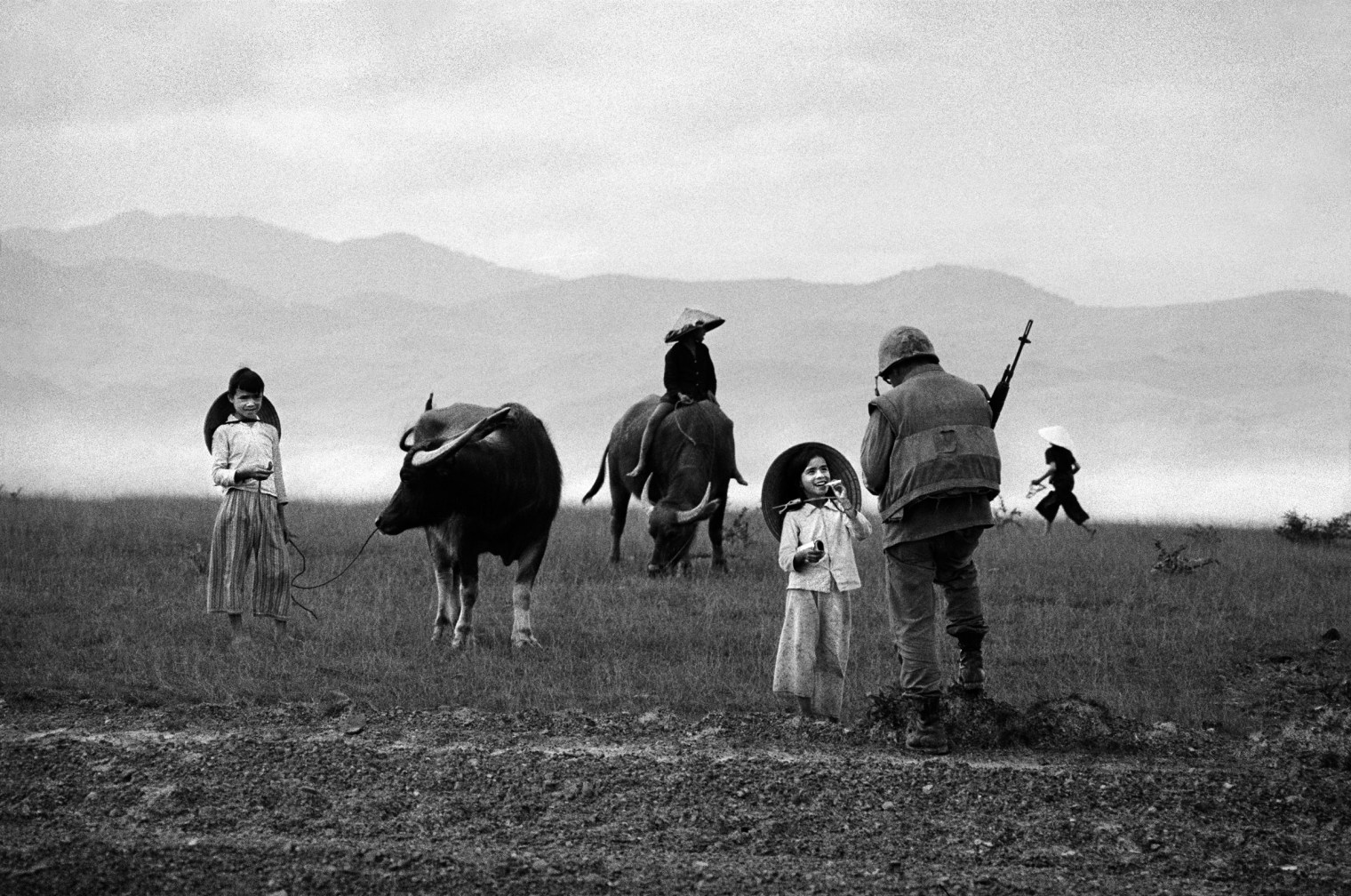
Philip Jones Griffiths—Magnum Photos
Fenella Ferrato, daughter of lensman Philip Jones Griffiths:
Philip Jones Griffiths was built-in in a minor town in the North of Wales in 1936, before the first of the Second World War. When American GIs landed on British shores they exuded generosity to their allies, giving away candy, nylons and cigarettes. I remember him telling the story of existence lined up in the playground and being handed a Mars bar by a tall GI. He was instantly suspicious. A Mars bar was a very special thing indeed. Why were these uniformed men just giving them away?
This was Philip'southward first glimpse into the efforts of an American ground forces trying to win over "hearts and minds." When he got to Vietnam he instantly recognized the same tactic being used there. This prototype perfectly shows the seductive and corrupting influence of consumerism on the innocent civilians of Vietnam.
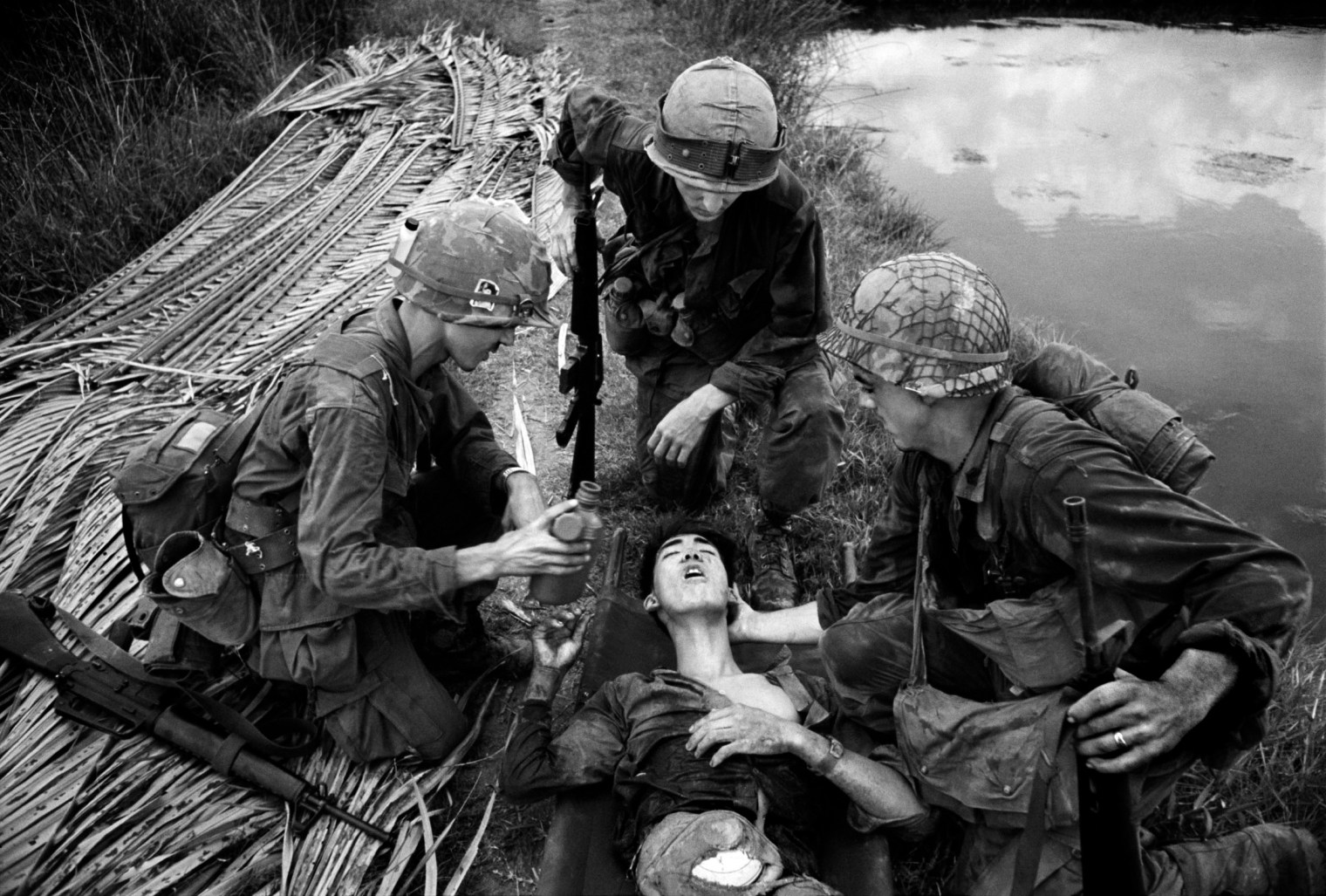
Philip Jones Griffiths—Magnum Photos
Katherine Holden, daughter of photographer Philip Jones Griffiths:
This picture was taken by my male parent, Philip Jones Griffiths, in Vietnam in 1968 during the boxing for Saigon. This is not a normal "war" photograph. It is not ofttimes y'all see "enemies" cradling each other. However, the American GIs ofttimes showed compassion toward the Viet Cong. This sprang from a soldierly admiration for their dedication and bravery — qualities hard to discern in the boilerplate government soldier.
This item Viet Cong had fought for three days with his intestines in a cooking bowl strapped onto his stomach. Francis Ford Coppola was so inspired by this image that he included a scene in his 1979 picture show Apocalypse Now with the famous line, "Any man dauntless enough to fight with his guts strapped on him tin potable from my bottle whatsoever day."
Henri Huet
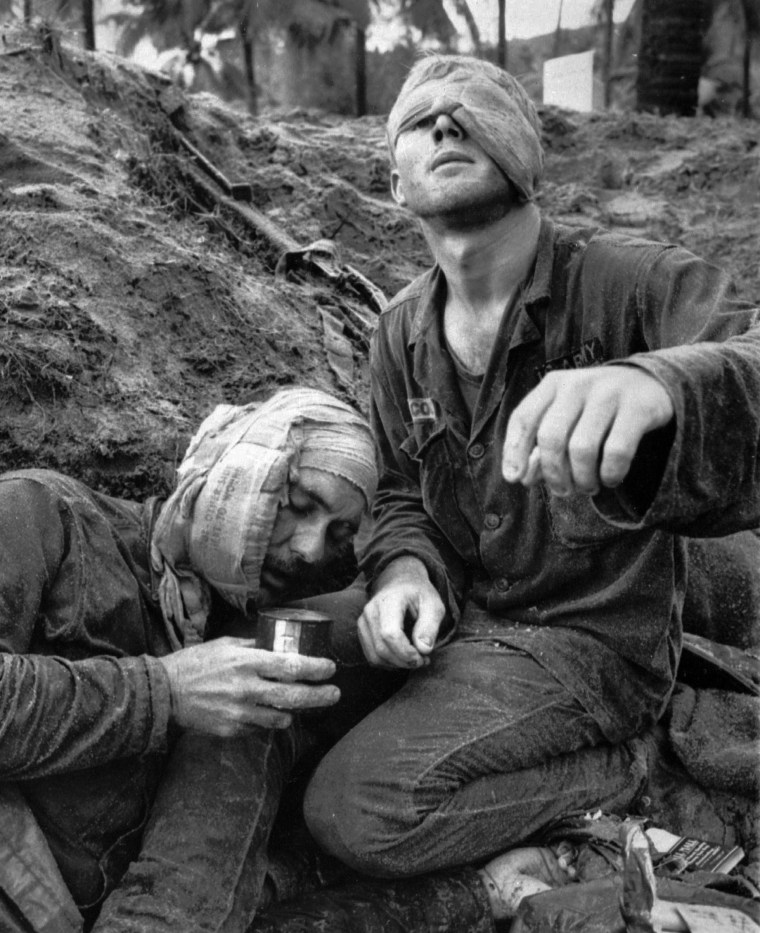 Henri Huet—AP
Hal Buell, former photography director at the Associated Press, who led their photo operations during the Vietnam War:
In all wars, the battlefield medic is oftentimes the stopgap betwixt life and death. AP photographer Henri Huet, under heavy enemy fire, saw that role through his lens and captured the uncommon dedication that medic Thomas Cole displayed in this memorable photo. Cole, himself wounded, peered below his bandaged eye to treat the wounds of a fallen Marine. Despite his wounds, Cole continued to attend the injured in Vietnam's central highlands in January, 1966. This photo was but ane of several Huet made of Cole that were published on the embrace and inside pages of LIFE mag.
A year later Huet was seriously wounded and was treated past medics until evacuated. In 1971 Huet died in a helicopter shot down over Lao people's democratic republic.
Tim Page
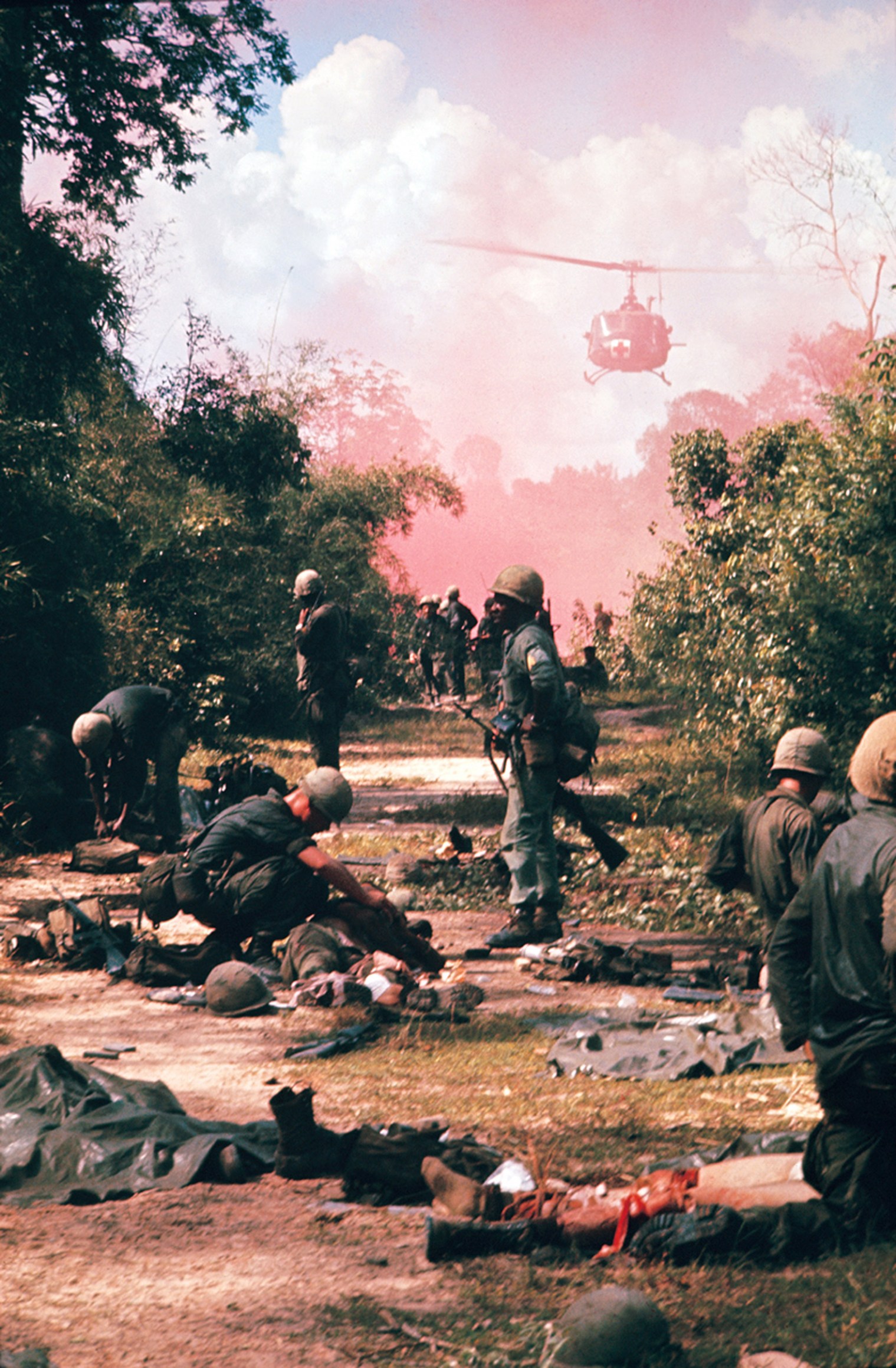
War Zone 'C' – Ambush of the 173rd Airborne, 1965. Tim Page
Information technology was Larry Burrows who had to teach me how to load my commencement Leica M3; I got it as a perk having only had this epitome run as a vertical double truck in a five-folio spread in LIFE in the fall of '65.
At the aforementioned time that Hello Dolly opened at Nha Trang airbase, a visitor of 173rd Airborne had walked into an ambush in Viet Cong base zone, known as the Iron Triangle. The sign had read "American who read this die."
A class of prime number youth shredded in seconds.
The grit-offs started coming inside 30 minutes. I got a ride back to Ton San Nhut and was downtown in Room 401 of the Caravelle in some other 30. Mostly, I remember conveying a desperately wounded grunt whose leg came off and he almost bled out. The shot was fabricated ane-handed as we carried him out of the fire cone.
Dirck Halstead
 Dirck Halstead—Getty Images
We rarely see images of Armies in full retreat.
More often than not, the photographers who might have shot some of those images have long since bugged out, or have been captured or killed.
In mid-April of 1975, a small group of American journalists were invited to fly into the pocket-size provincial uppercase of Xuan Loc, S Vietnam, 35 miles north of Saigon, by commander Le Minh Dao. A siege by a massive North Vietnamese strength was most to have place. The helicopter Dao sent to Saigon to choice u.s. up deposited us but outside the town. Neither we, nor General Dao, had expected the tide of advancing communist forces to so apace and completely surround the town.
General Dao, yet, was full of vim and eager for the battle. Slapping a swagger stick along his leg, he quickly loaded the ii journalists who had accustomed his invitation, myself and UPI reporter Leon Daniel, into a Jeep and barreled into the town. At kickoff, we thought it was deserted. Then slowly, and i by one, South Vietnamese troopers began to stick their heads out of foxholes they had dug in the streets. Dao yelled that they were prepared to fight the enemy, come what may. Nonetheless, we noted with more than a petty trepidation that none of them were budging from their holes as Dao led us downwardly the dusty street. Suddenly, a mortar shell landed in the grit no more than ten anxiety from us. Information technology was followed by a barrage of incoming automatic weapon and artillery rounds.
Dao wisely called an end to his press bout. We tore back to a landing zone that nosotros had arrived at less than an 60 minutes later. Dao called in a helicopter to evacuate the states, just of a sudden, the ARVN troops who had been seated aslope the route broke and ran for the incoming helos. In less time than it takes to tell, the panicked soldiers swarmed into the helicopter, which was to exist our just mode out. Crewmen tried to turn them dorsum, just the helicopter lurched into the air with ii soldiers hanging from the skids.
At that moment, Leon and I had a sinking feeling that we were going to be part of the autumn of Xuan Loc. For us, the war looked like it was nigh to exist over.
However, Dao had one more trick upward his sleeve, and he called in his personal helicopter behind his headquarters. As we made a run for it, the General grabbed me past the arm, and said, "Tell your people that you accept seen how the 18th sectionalisation knows how to fight and die. Now go — and if you are invited back, don't come up!"
Joe Galloway
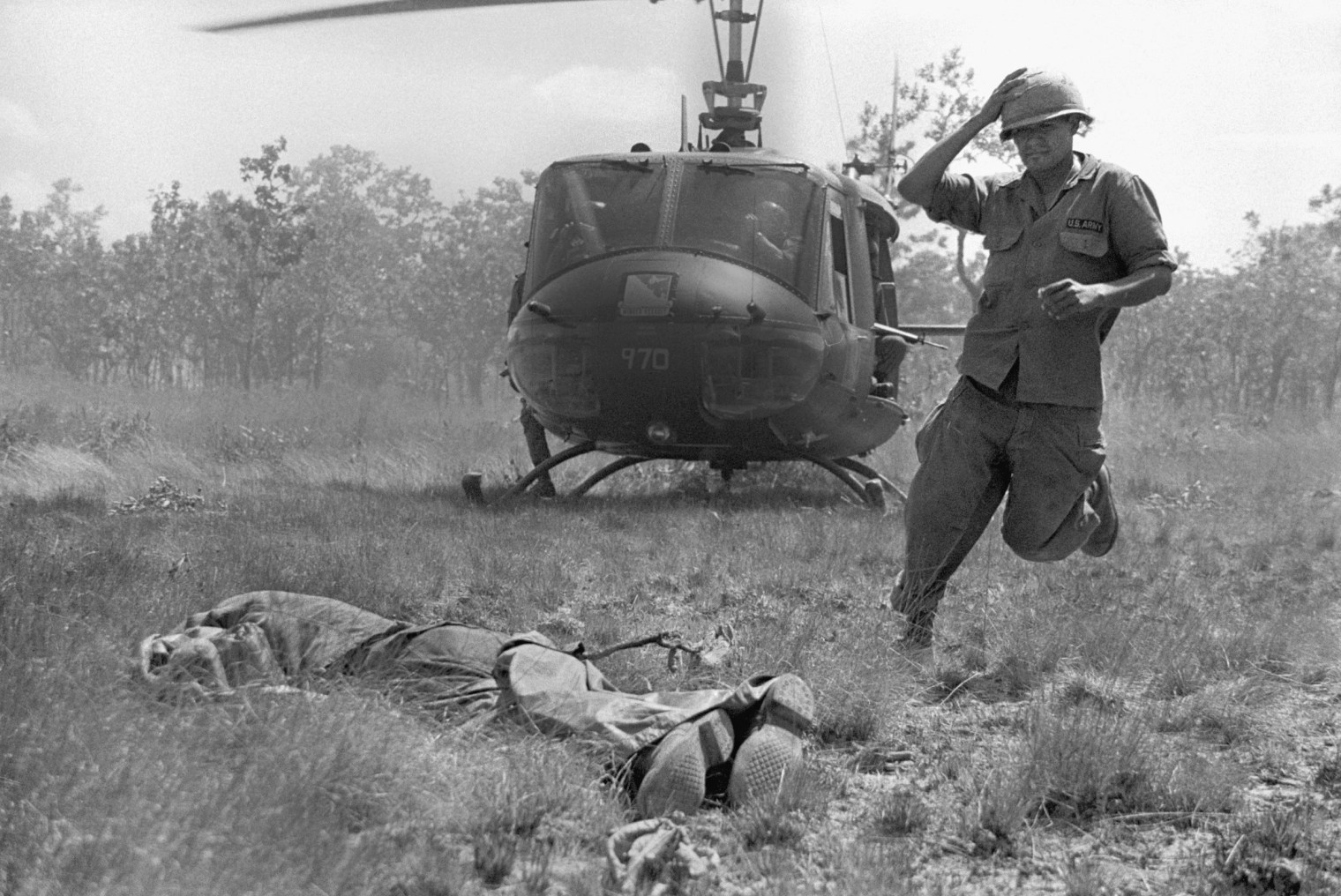
Joe Galloway—UPI/Getty Images
I snapped this photo at [the Battle of la Drang], LZ X-Ray, on Nov. 15, 1965. At the moment I hit the push button I did non recognize the GI who was dashing across the clearing to load the body of a comrade aboard the waiting Huey helicopter.
Later I realized that I had shot a photo, in the oestrus of battle, of my childhood friend from the petty boondocks of Refugio, Texas. Vince Cantu and I went through schoolhouse together right to graduation with the Refugio High School Class of 1959 — a full of 55 of u.s.a.. The next time I saw Vince was on that terrible bloody ground in the la Drang. Each of us was terribly afraid that the other was going to exist killed in the next minutes.
When my book near the war, We Were Soldiers One time…and Young, came out in 1992, Vince Cantu was driving a city bus in Houston. His bosses read the papers and discovered they had a real hero pushing one of their buses. And then they made Vince a Supervisor and all he did from and then to retirement was stand in the door with a clipboard checking buses in and out.
A story with a happy ending.
Larry Burrows
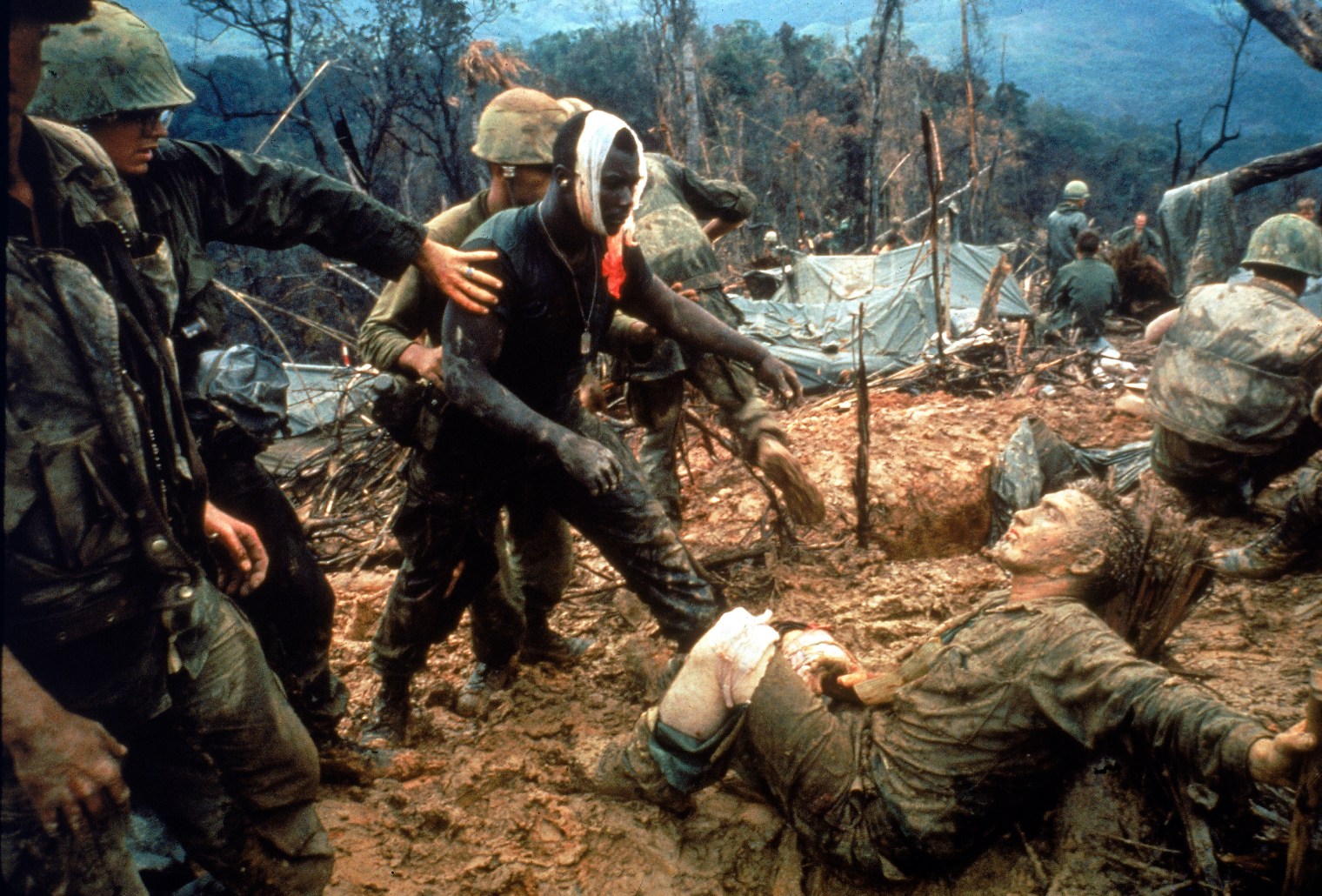 Larry Burrows —The Life Picture Collection
Russell Burrows, son of lensman Larry Burrows:
The fraction of a second captured in virtually photographs is but that: a snapshot of a moment in time. Sometimes, fifty-fifty in state of war, that moment tin can tell a whole story with clarity, but it tin exist ambiguous besides.
The photograph that ran in LIFE in late October 1966 of Gunnery Sergeant Jeremiah Purdie, bleeding and bandaged, helped down a muddy hill by swain marines, didn't really need a caption. The written account around the photo and a dozen others that brought Operation Prairie to LIFE's readers told of infiltrating troops and of efforts to thwart them — of hills taken and given up. The particular not given was that Gunny Purdie's commanding officer had simply been killed on that hill, the radio operator "cut in half." Neither did the commodity mention that the CO had called in artillery burn down on his own position. Purdie was being restrained from turning dorsum to assist his CO.
A few frames after, Larry Burrows took some other photograph: Purdie is still being held back, but in front end of him is another wounded man and Purdie's artillery are outstretched. The scene is as wretched as the other. Purdie, wounded for the third time in the war, was nearly to be flown to a hospital transport off the Vietnamese coast and get out that land for his last fourth dimension. This photo has come to exist known as "Reaching Out."
My father, Larry Burrows, selected that frame himself, but information technology wasn't until more than four years later, afterwards he was shot downwardly and killed, that information technology was published for the first fourth dimension. The composition of the photograph has been compared to the work of the old masters, simply some run into it more than cinematically: equally if you lot could run a film backwards and forwards to view more of the story. Exhibiting museums have constitute in it Christian iconography. And at least one psychiatrist treating war veterans has used it in his exercise.
My male parent didn't know that Jeremiah Purdie had enlisted in a segregated Marine Corps 18 years before, that cooking in the mess and polishing shoes were the limits placed on his service. He didn't know that earlier Purdie's persistence finally earned him a transfer to the infantry, he had taken courses at the Marine Corps Institute, confident that the transfer would come and he would be ready. Unknowable then was too the life Purdie would live after his twenty years in the Marine Corps, or how of import to him faith would get.
At Jeremiah Purdie'south packed funeral, there wasn't a man or a woman with a story to tell that didn't mention how, in some way, he had reached out.
David Hume Kennerly
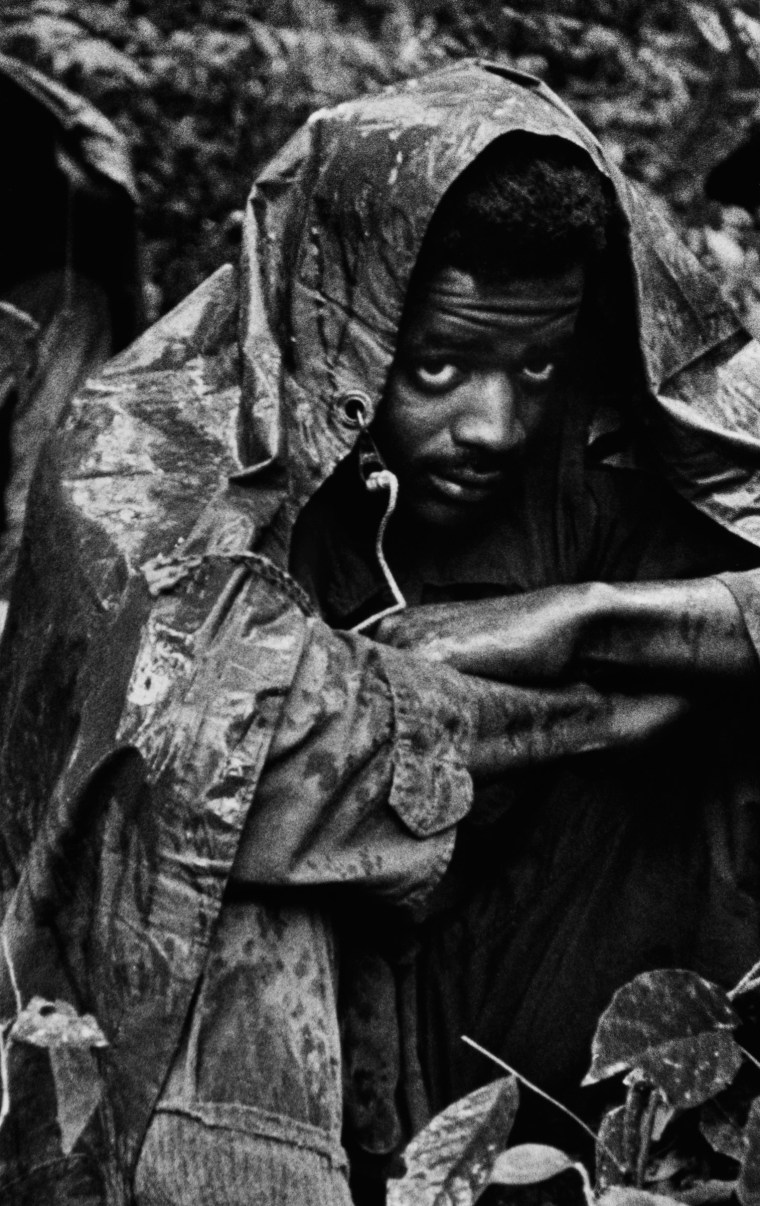 David Hume Kennerly
Long-forgotten photographs sometimes bound out at me and I am stunned past sure moments that I documented that were and so routine when I made them, merely are at present infused with new emotion and meaning. This picture of a haunted-looking young American GI taking refuge under a poncho from monsoon rains in the jungles outside of Da Nang while on patrol in 1972 is one of them. The soldier's eyes reveal, and you don't demand a explanation to explain information technology, that he most likely experienced hell along the mode.
During the time I spent with him and his platoon they didn't come into direct contact with the enemy, but at that place was always a common undercurrent that ran through them, a palpable anxiety and fear about what could come up their manner in a split 2nd. These men had seen buddies cut in half by shrapnel from an incoming round, or watched a friend's head explode from a bullet betwixt the optics that earned him a one-way ticket home in a trunk bag. Many had that intense bonfire of realization when a comrade was suddenly, violently, unexpectedly gone, and marveled at still existence left intact. Some experienced a flash of guilt when in a starkly honest millisecond they thought, "Glad it was him, not me." That big ugly candid moment was immediately pushed downwards, but information technology would creep dorsum every now and then, especially back in the globe when they gave a hug to their new child, the i their dead buddy would never take.
This image of the sheltering soldier is particularly compelling to me for what I don't know. What was his adjacent act, and what happened after he returned from Vietnam? The photograph didn't win any prizes, might not even been published, just every bit a flash forward information technology represents every soldier who returns from whatsoever war after the battles were history, guns silenced and the odds of getting killed beaten.
Paul Schutzer
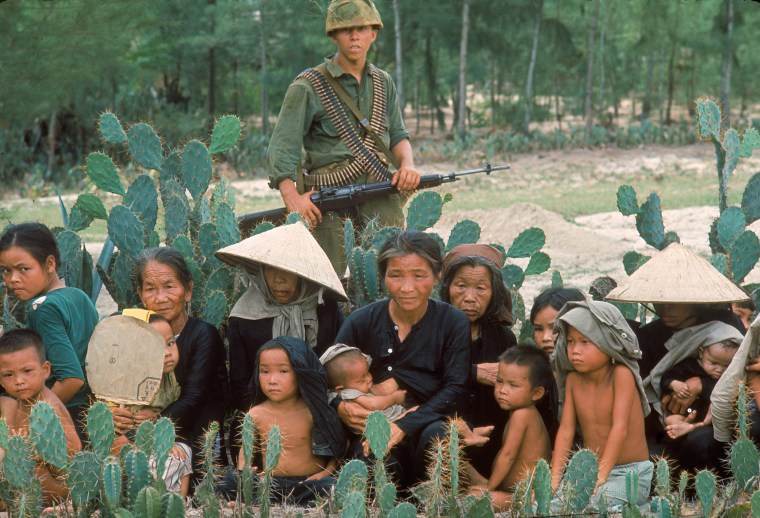
 Paul Schutzer—The Life Picture Drove/Getty Images
Bernice Schutzer Galef, widow of photographer Paul Schutzer:
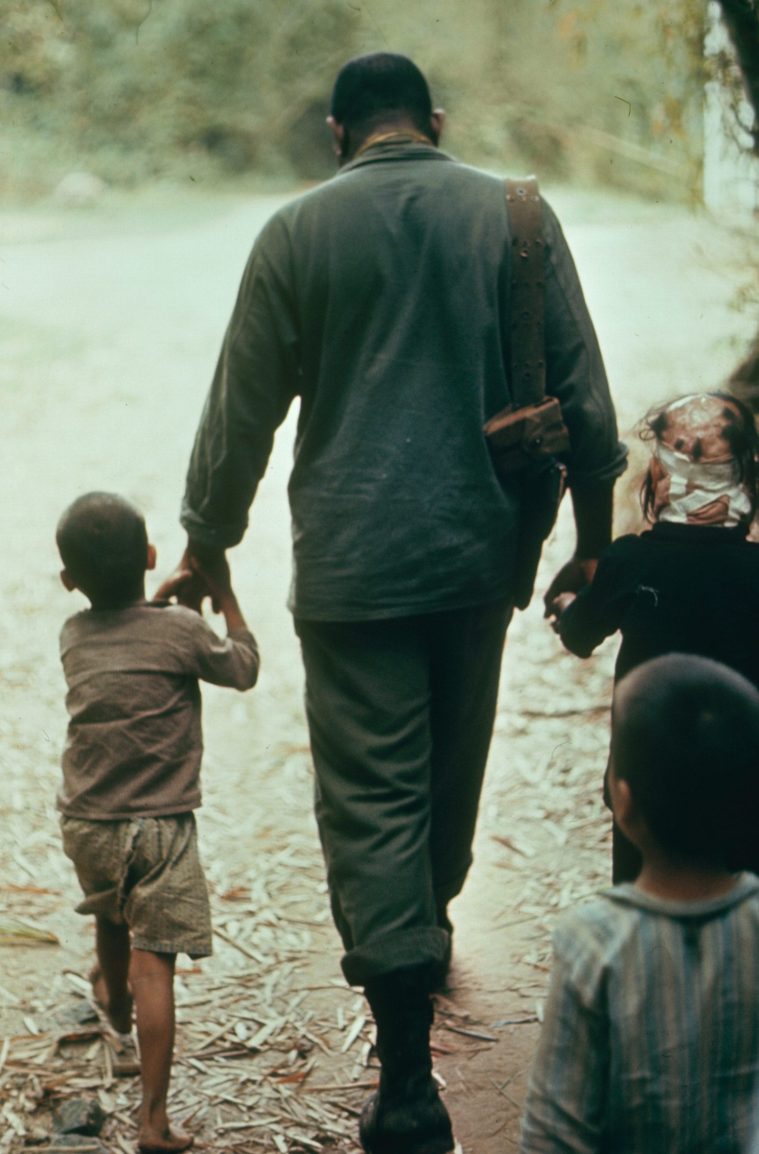
Paul got carried away with all the emotions that happen in war, and he was correct in there with the soldiers in battles. He saw everything; he saw the fatigue of the American soldiers, their fear, the prisoner'south fearfulness. There was one photo of prisoners being guarded past an American soldier about eighteen years one-time. The captives were young children and old women and one woman is nursing her infant. Unfortunately the young soldier was later killed but this image conveyed the senselessness and horror of how the man condition was playing out. The soldiers were very sympathetic to the civilians and one medic befriended them. The last photograph in the photograph essay shows the medic and a child walking away together, holding hands, and the child'due south head is burned from napalm. It was the first fourth dimension that Americans saw and learned that we were using napalm. Paul received many letters saying "give thanks you for what y'all showed us."
David Burnett
David Burnett—Contact Press Images
In the days earlier "embeds" — this generation'due south enforced melding of photographer and armed forces unit — in that location was a certain sense of freedom we owned as photographers, beingness able to go direct to where the story was. In Vietnam in the early 1970s, the only real limitation was finding a ride. But nearly until the end of the U.S. war, if a helicopter or truck had a seat available, they would take you lot forth.
We would often "embed" ourselves with a platoon or squad, just information technology was more than of a gentleman's agreement than any kind of official policy, based in the main on the idea that we, the photographers, were at that place to tell their story, and they, the soldiers, realized that unlike them, we didn't have to be there. Information technology was by choice. Information technology created a sense of common respect that in many ways is challenged by the new "embed" ethos. That said, it was frequently a earth of bearding photographers spending time with anonymous soldiers. And so while we would talk with the troops about what was happening that day, at that place were many moments where in the course of making photographs, I would just continue moving along. I usually knew the unit but looking back now, so much I wish I had noted was simply never written down. It was forever a search for a moving-picture show, and you never knew, sometimes for weeks, whether you had that picture or not. My film had to make it all the way to New York before information technology could be processed and edited.
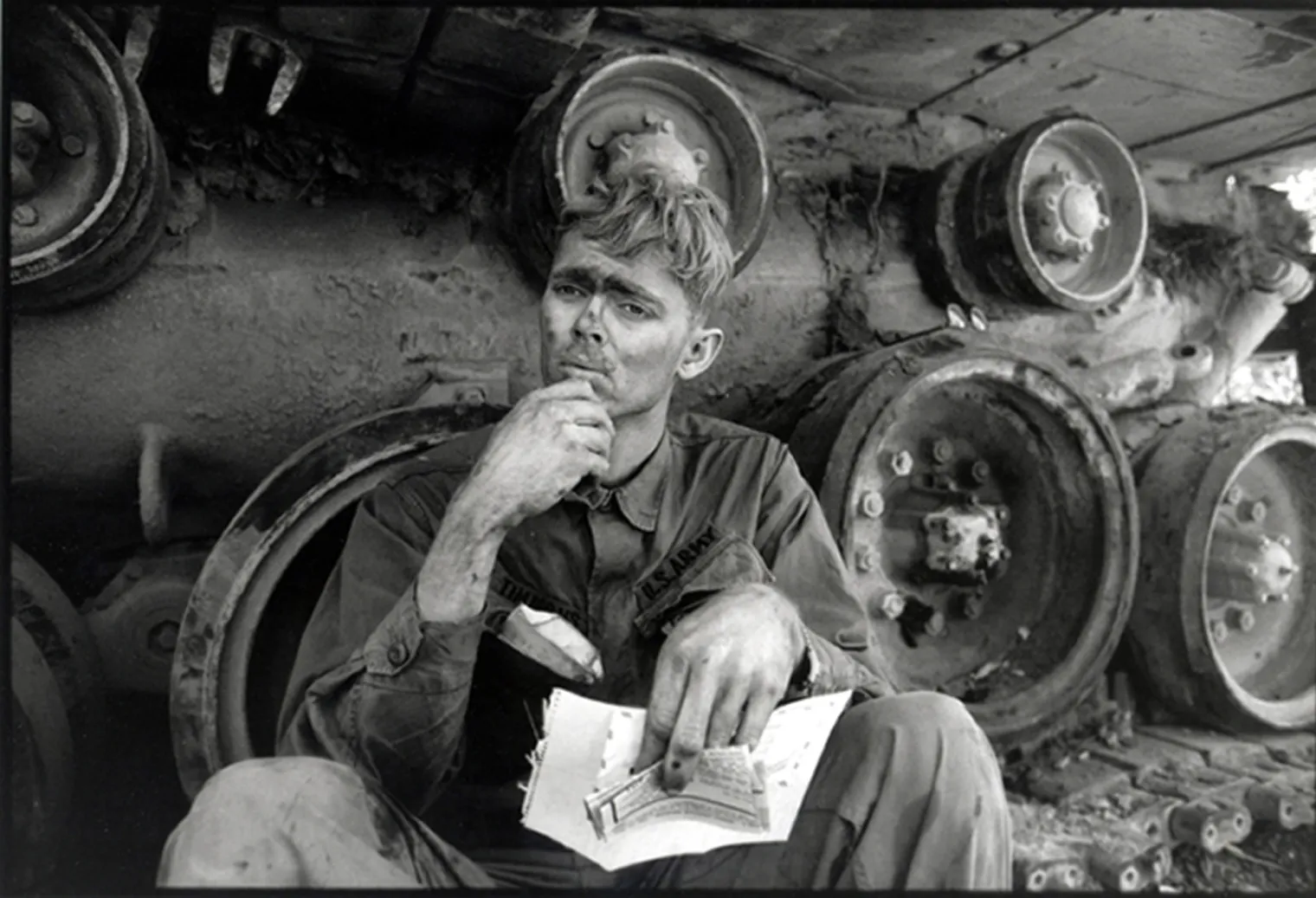
One forenoon near the end of the unsuccessful Laos invasion of early 1971 (an try to cut the Ho Chi Minh trail), I wandered into a grouping of young soldiers who were tasked with fixing tanks and runway vehicles which were regularly being rocketed by Northward Vietnamese troops just downward the route. This soldier and I exchanged pleasantries the way you would in the dusty oestrus. He went back to work after reading a alphabetic character from habitation, and I moved on to another unit of measurement. But for that fraction of a second, in his face up, his posture, was all the fatigue and despair of a young soldier who is surely wondering what in the hell he's doing there, so far from home.
Catherine Leroy

Catherine Leroy—Dotation Catherine Leroy
Fred Ritchin, Dean Emeritus of the School at ICP:
There is something both surreal and strikingly sad in this photograph by Catherine Leroy. An empty helmet — is its owner nonetheless alive? — is shown front and center, resting on the basis in the soft gray light like a discarded soup bowl or a cleaved skull. It is photographed every bit if forming the centre of a cleaved compass, one without arms, pointing nowhere. In the fairly rendered background a soldier, probably wounded, is seen surrounded by comrades who, somehow, course an awkward Pietà. The vehement spectacle has temporarily receded, and the reader, in this previously unpublished photograph, is given its remains, both the sacred and the partly absurd.
Leroy went from France to Vietnam in 1966 at the age of 21, with a single camera, no assignments and $150 in her pocket; she would stay until 1968. She managed to become accredited by the Associated Press, covered numerous battles, was seriously wounded by shrapnel that would remain in her torso, parachuted into combat (small and thin, she was weighed downward and then every bit not to be blown away), was taken prisoner by the Due north Vietnamese (which she used as an opportunity to produce a cover story for LIFE Magazine), and remained obsessed by the war until her expiry in 2006.
Consumed past a ferocious anger at the hypocrisies of politics at diverse levels, in her concluding years Leroy created a website and then a book, Under Burn: Great Photographers and Writers in Vietnam, paying homage to her colleagues forty years afterwards the war had ended.
Sal Veder
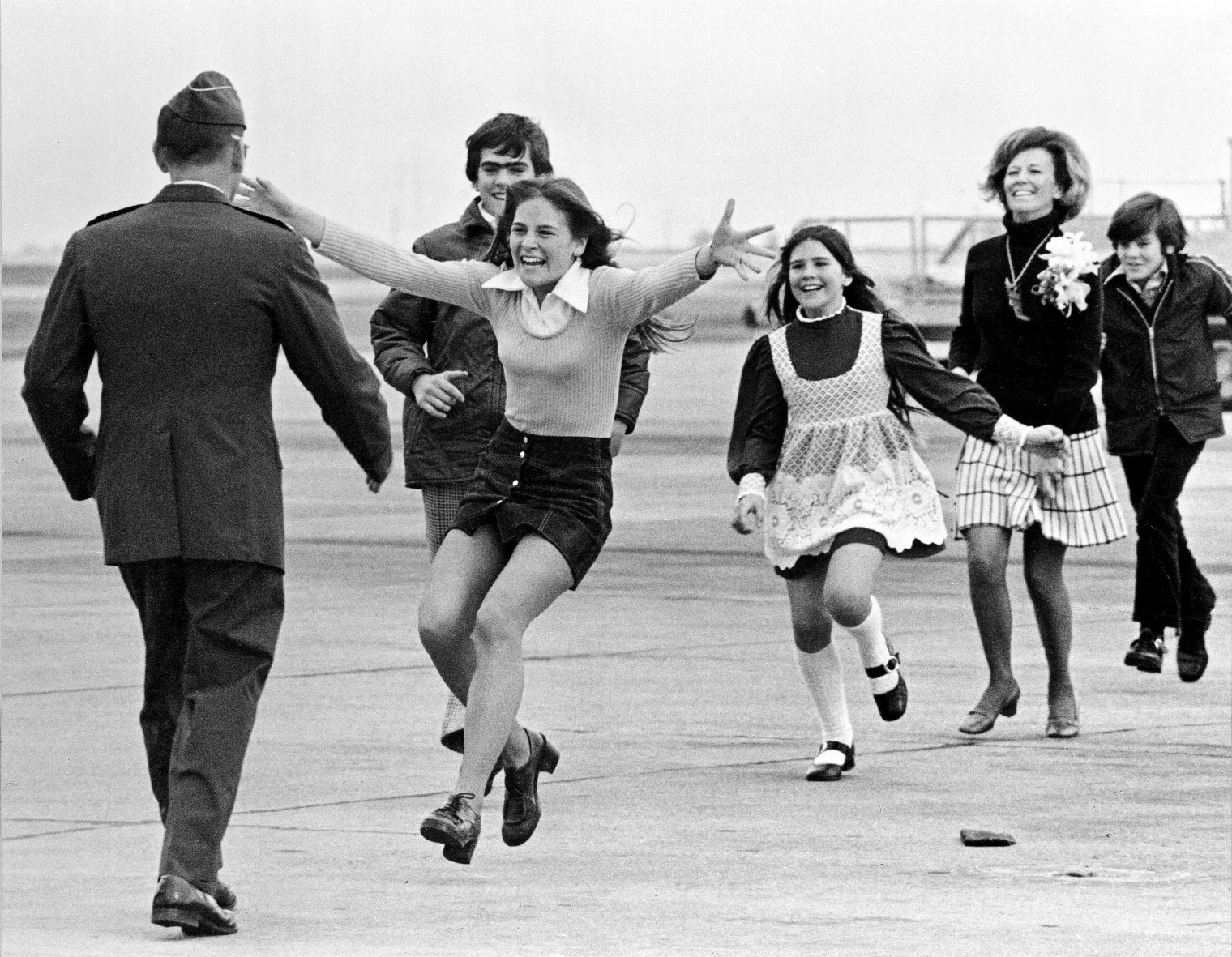
Released prisoner of war Lt. Col. Robert 50. Stirm is greeted past his family unit at Travis Air Force Base in Fairfield, Calif. Sal Veder—AP
I had photographed POWs returning home time and once more, and been in Vietnam on 2 tours myself, every bit a lensman. On that twenty-four hour period, There were thirty or 40 photographers boarded on a flat-bed, including Television receiver. I was photographing a different family and out of the corner of my heart saw the activity and turned. I was lucky to become a break. It was a neat moment for Americans! The joyousness of the reunion and the coming together of the family every bit a visual is outstanding because it was the end of the war. We were glad to get it over with. I'chiliad thankful that this is my pic. I feel it's symbolic, but I'one thousand conflicted nigh information technology, knowing what I know. The picture is there and it comes support again. There is no way to avert it.
Nick UT
Nick UT—AP
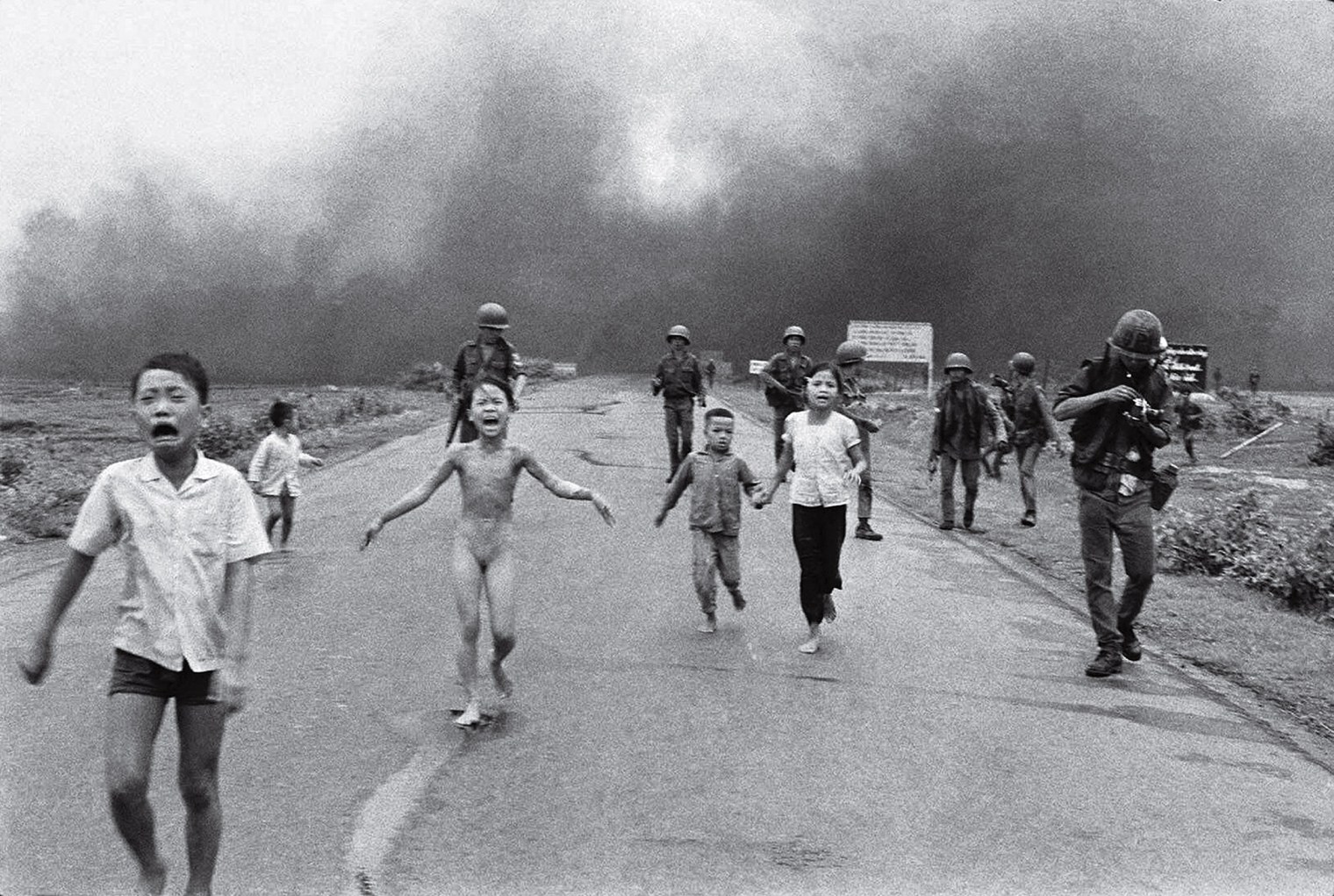
My older brother Huynh Thanh My, who was killed covering the Vietnam War for the Associated Press, always told me that an image could stop the war and that was his goal. I was devastated when he died. I was very young. But at that place and and then, I decided to follow in his footsteps and consummate his mission. A few years afterwards that fateful day in 1972 on the Trang Blindside route, my brother's goal was achieved. No one was expecting people to come out of the bombed-out called-for buildings, but when they did, I was ready with my Leica camera and I feel my brother guided me to capture that prototype. The rest is history.
Yoichi Okamoto
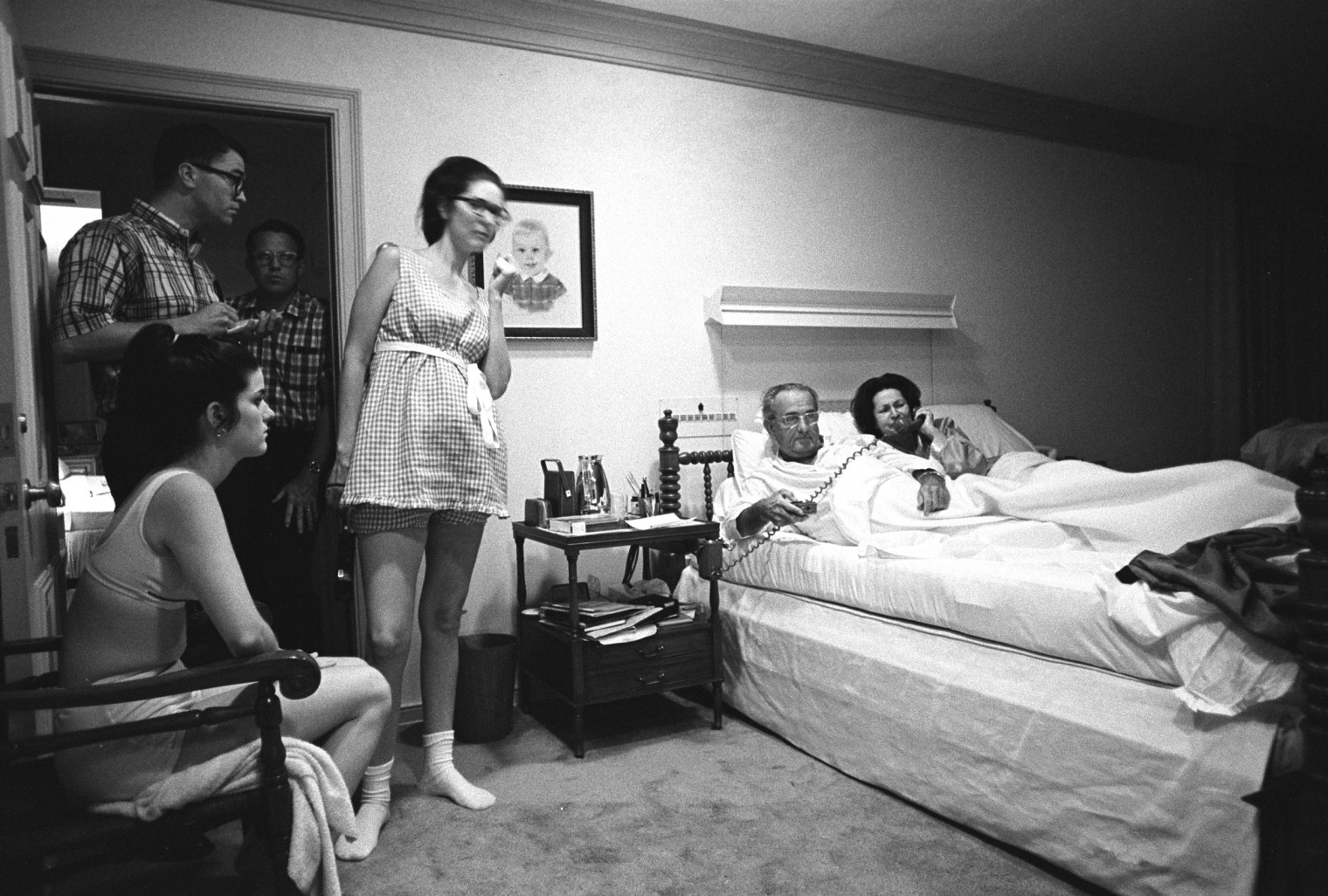
As tens of thousands of anti-war protestors rioted in Chicago during the 1968 Autonomous National Convention, President Johnson and his family watched from the bedroom at his ranch in Stonewall, Texas. Yoichi Okamoto—LBJ Library
Pete Souza, sometime White House lensman for Presidents Reagan and Obama:
This is truly an incredibly intimate motion picture. The caption provides pertinent information about the circumstance: the who, what and where. But I'thousand fascinated past the photograph because of the man behind the camera: Yoichi Okamoto. The first civilian hired equally Chief White House Lensman, Okamoto as well became the kickoff 1 to truly document the Presidency for history. It's obvious looking at this photo that he had unfettered access to LBJ and that anybody was comfortable with him beingness in the room — even when the room was the President's bedroom.
Raymond Depardon
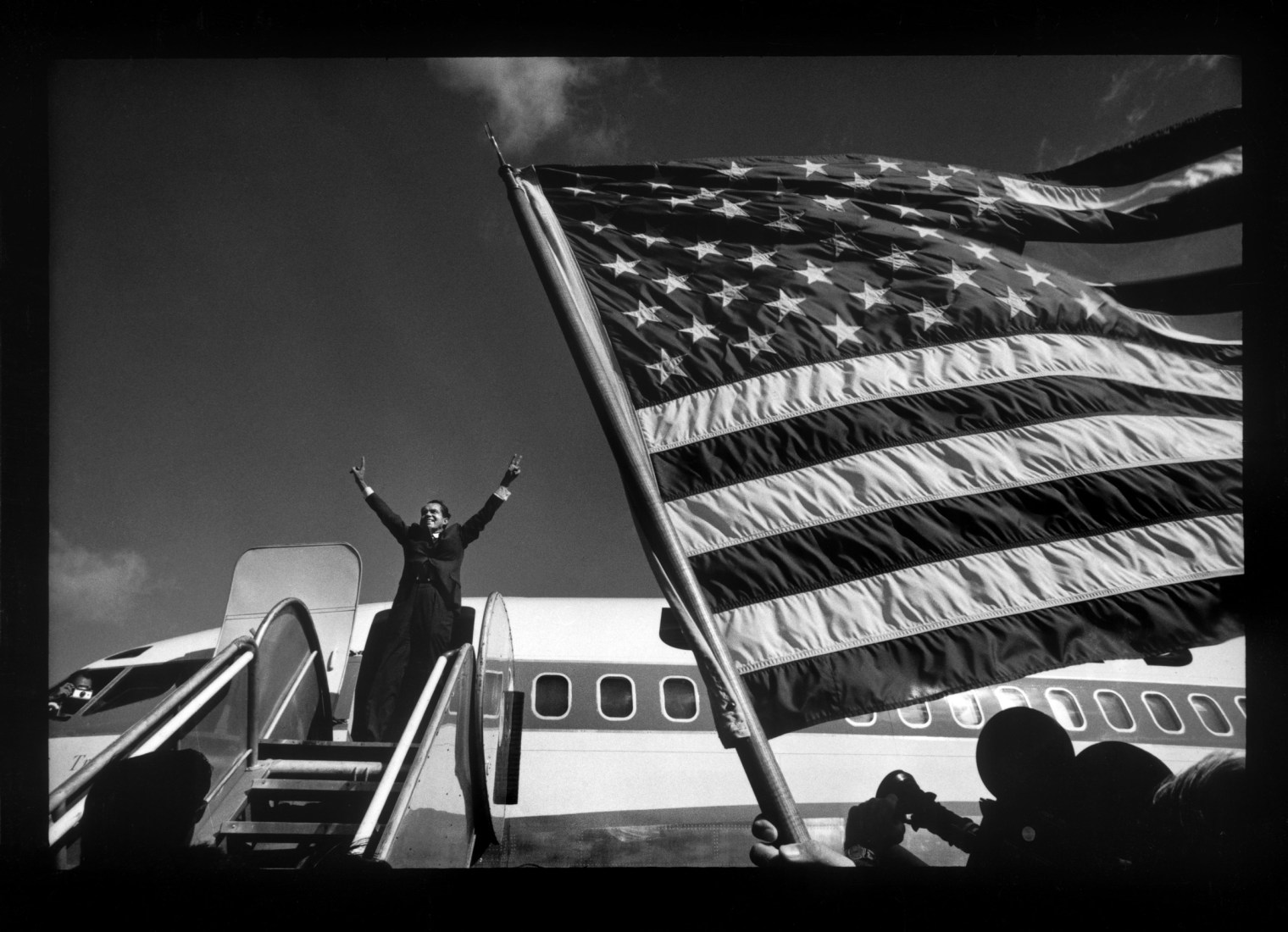
Richard Nixon campaigns in Sioux City, Iowa, October 1968. Raymond Depardon—Magnum
(Translated from the French)
Later I photographed the Autonomous Convention in Chicago, which was very turbulent and contested, I wanted to photograph the future President. I worked for a little cooperative French agency, Gamma, which we had created a few years before. I arrived from Miami on the printing airplane that accompanied the candidate. Nosotros were positioned at a fiddling airport in Sioux City. It was the forenoon. Information technology was windy. Nixon left the airplane.
I almost did not make the photo — the man with the flag and Nixon on top of the aircraft stairs. It was too much.
Art Greenspon
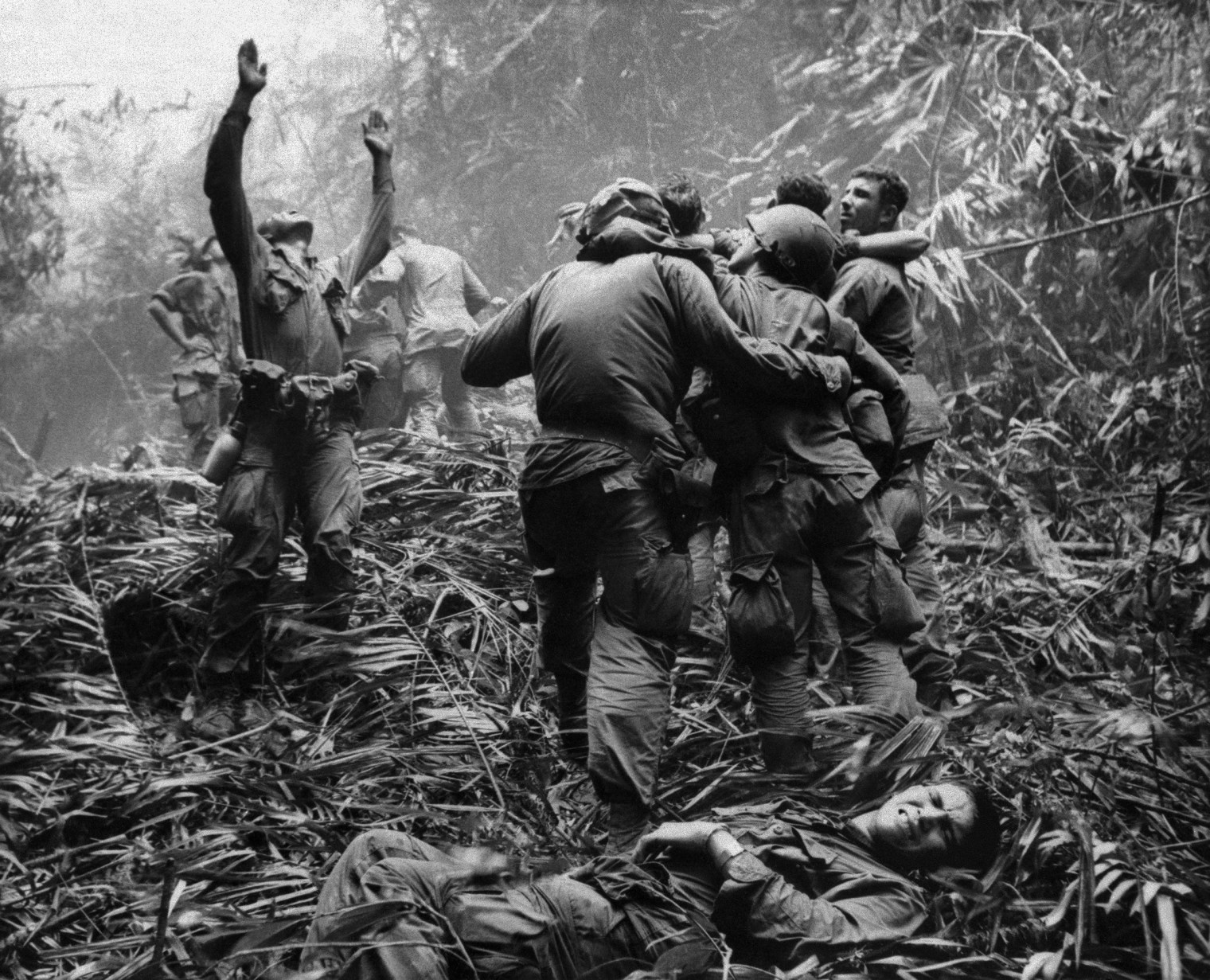
Art Greenspon—AP
Excerpted from a 2013 interview with Art Greenspon by Peter van Agtmael, a Magnum photographer who has covered the wars in Iraq and Afghanistan:
"As the offset medevac chopper hovered overhead I saw the First Sergeant with his arms in the air. I saw the medic shouldering wounded and and so I saw the child on his back in the grass. I have got to get all this in one picture, I thought. My heart was pounding. Was 1/lx fast enough? Spiral it. Shoot pictures. I got three frames off, and the moment was gone.
I knew what was in the photographic camera, only when I went to wind back the film, I couldn't. The flick in my Nikon had become stuck to the pressure plate from all the moisture. My Leica was soaked, too, and I wasn't sure what kind of pictures it was producing.
The weather closed in once more. I had given all of my food abroad so I didn't eat for ii days. I wrapped my cameras in a clammy towel and put them in my pack. I guarded that pack like a female parent hen.
I flew out with the 2nd chopper loaded with body bags. A kid headed out for R&R and a floor stacked with KIAs [killed in activeness]. War sucks."
Alice Gabriner, who edited this photograph essay, is Fourth dimension'south International Photo Editor.
Lily Rothman is the History and Archives Editor for TIME.
Source: https://time.com/vietnam-photos/
0 Response to "Platoon Takes Picture With Baby of Fallen Comrad"
Post a Comment