Which Group of Immigrant Men Spent the Least Amount of Their Leisure Hours With Their Families?
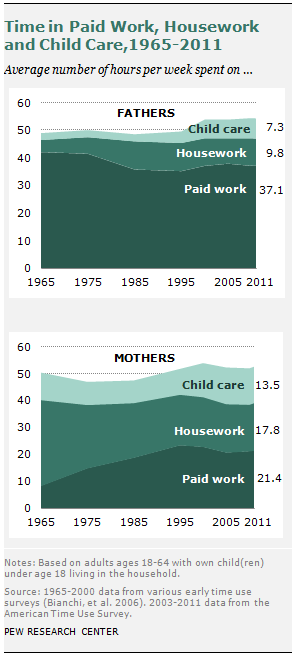 The work lives of American men and women take become more than similar since the 1960s, measured past time in both paid work for a task and unpaid work at dwelling. The average hours spent per week at job-related activities has declined from 42 hours in 1965 to 37 hours in 2011 for fathers, but increased from 8 hours to 21 hours for mothers.15
On the home front, fathers today spend more than than twice equally much time doing housework as they did in the 1960s (10 hours vs. four hours per week), and mothers have cut their housework time almost in half during the same period (xviii hours vs. 32 hours per calendar week). These analyses are based on historical time diary data16 as well the more recent American Time Employ Survey, which asked nationally representative samples of Americans well-nigh activities they did in the previous 24-hour interval sequentially.
Parents' time with their children continues to go up. Fathers have well-nigh tripled their time with their children (from 2.five hours in 1965 to 7.3 hours per week in 2011). After a reject in the 1970s and '80s, mothers' time with their children has also increased, and today'southward mothers spend more time with their children than mothers did in the 1960s. Despite the increase in child care time amidst fathers, American mothers spend about twice every bit much fourth dimension with their children as fathers do.17 In 2011, the average kid care time is 7.3 hours per week for fathers and 13.5 hours per week for mothers.
 The full work time for parents, which includes both paid and unpaid (housework and child care) piece of work, has increased slightly over more than 4 decades, and the total workload for mothers and fathers has been about identical. In 1965, fathers spent about 49 hours per week in paid work, housework and child care combined, compared with 54 hours in 2011. Mothers' total piece of work time was 51 hours in 1965 and 53 hours in 2011.
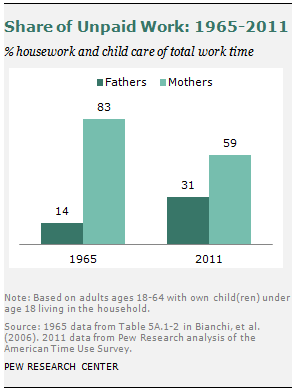
What has inverse more over this period is the allocation of fourth dimension. More than 80% of mothers' work time in 1965 was spent taking care of the house and caring for children; that share dropped to about 60% by 2011. In contrast, more than of fathers' fourth dimension is now spent in unpaid piece of work; the share of work time fathers devote to housework and caring for children has increased from fourteen% to 31%.
Work and Leisure Time among Parents in Different Types of Families
American families have undergone dramatic changes in the past 5 decades, equally the share of adults who are married has declined from 72% in 1960 to about 50% today.eighteen Compared with single fathers and fathers who alive with a partner, married fathers piece of work longer hours in their job and take the least amount of leisure time. Married mothers, meanwhile, spend more fourth dimension in housework than do single or cohabiting mothers, just they also have the to the lowest degree amount of leisure time. Equally a outcome, married parents spend more than time at work than single parents, counting housework, child care and paid piece of work together, and have less leisure time than other parents.
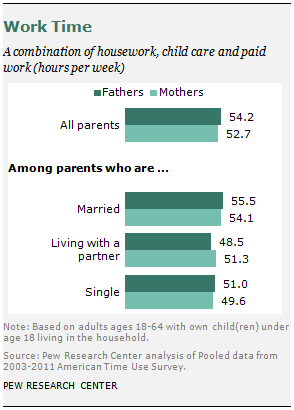 On average, married fathers' overall weekly workloads are 1.iv hours more than those of married mothers, while the workload for cohabiting fathers is almost three hours less than that of cohabiting mothers. Single fathers' overall work time is slightly longer than that of unmarried mothers (51 hours per week vs. 50 hours). Regardless of their family arrangements, fathers in general take more leisure time than mothers.
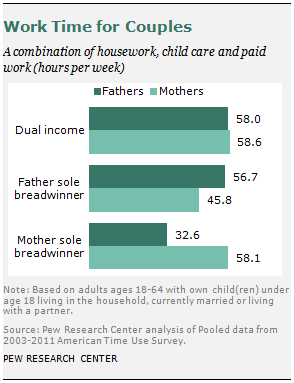 The gender gap in work and leisure is more than closely related to how couples arrange their paid and unpaid piece of work. Amongst parents who are married or living with a partner, dual-income couples are the well-nigh egalitarian couples, even though they exercise non dissever upward their piece of work in a 50-l style. Dual-income fathers spend about 11 hours more than mothers in paid work per week, but mothers make up their hours past spending more time on average time in child care and housework. Dual-income fathers have more leisure time than mothers; the gap is about four.v hours per week.
Time in work and leisure is somewhat unbalanced among single-income families, especially when the mother is the breadwinner. Working mothers are overburdened in this arrangement: They spend almost 25 hours more in total work time per week, just 20 hours less in leisure, than their non-employed partners do. In contrast, when working fathers are the sole breadwinner, their overall piece of work time is about 11 hours per week more their non-employed partner's, and their leisure time is well-nigh four hours less than their partners' leisure fourth dimension.
How Do Parents Feel nearly their Time?
 Findings from the time diary data are largely echoed by how parents feel nigh their time in a contempo Pew Research Center survey. Virtually half of adults with children nether age 18 (49%) say that they spend more time with their children than their parents did when they were young. One-third say that their ain child care fourth dimension is the same as their parents'. This is consistent with the rising child care time for parents since the 1960s based on the time employ data.
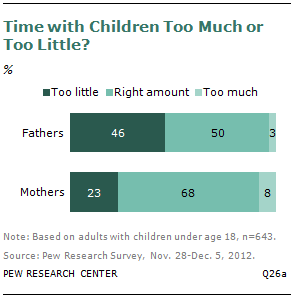
 Given that American fathers' time with children is just about half of mothers', information technology is not surprising to find that American fathers with children under historic period eighteen are twice as probable as mothers to say they don't spend plenty time with their children. According to a recent Pew Research survey, 46% of fathers say they spend too little time with their children, compared with 23% of mothers. A bulk of mothers (68%) say they spend the right corporeality of time with their children, compared with only half of fathers.
When information technology comes to "who does more" kid care equally well every bit household chores and responsibilities among married or cohabiting parents, both mothers and fathers indicate that mothers commonly practise more—although a higher share of fathers report that these responsibilities are shared as.
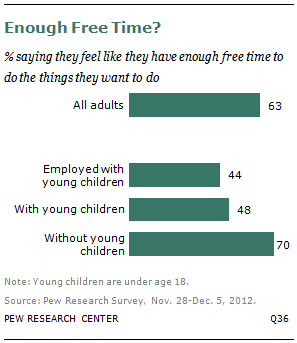
Fifty-fifty though findings from the time apply information suggest that generally men spend more time than women in leisure activities, there is no meaning gender difference in how adults view their free fourth dimension. Among parents with children nether age 18, 48% say that they more often than not feel similar they have enough complimentary fourth dimension to do the things they want to exercise. The share falls to 44% amongst working parents with young children. In contrast, a vast majority of parents without young children (70%) report that they have enough costless fourth dimension, in role because a higher share of these adults are retired.
The rest of this section goes into details most the long-term trend of Americans' time at work and at dwelling house as well as time use patterns among parents of dissimilar family types and living arrangements. Public stance questions related to time utilize are as well discussed when available.
Source: https://www.pewresearch.org/social-trends/2013/03/14/chapter-4-how-mothers-and-fathers-spend-their-time/
0 Response to "Which Group of Immigrant Men Spent the Least Amount of Their Leisure Hours With Their Families?"
Post a Comment