What to Do With a Health Science Degree
Y'all're an experienced professional with an associate degree. But now you lot need a bachelor's caste. A Bachelor of Science in Biomedical Science: Health Sciences prepares you to presume a wide range of roles within both clinical and non-clinical settings, such every bit medical lab technologist, claims reviewer, and healthcare administrator.
In full general, students earn a wellness sciences caste to:
- Advance their electric current healthcare careers to the adjacent level
- Change jobs or industries
- Fix for graduate or professional programs, such every bit chiropractic programs, physical or occupational therapy, healthcare informatics, athletic training, or healthcare administration
What Is Wellness Science?
Health science is the application of science to health including the study of medicine, diet, and other health-related topics.
A bachelor's degree in health sciences provides essential healthcare knowledge and skills while edifice professional skills sought by healthcare employers, such as critical thinking, problem solving, leadership, information literacy, and information management.
Health Sciences Jobs and Career Paths
Positions in the health sciences range from clinical work with frequent patient contact to office piece of work at private corporations. Because healthcare is such a various field, health sciences graduates have the ability to move both laterally and upwardly as career interests and goals change.
If you are interested in a wellness sciences bachelor'south degree, y'all might be a…
- Cardiovascular technician
- Anesthesia technician
- Dental hygienist
- Occupational therapy assistant
- Physical therapy assistant
- Respiratory therapist
- Surgical technician
- Registered health information technician
- Biomedical equipment technician
- Medical lab technician
- Cancer registrar
- EKG technologist
- Audiology technician
- Chemist's shop technician
- Paramedic
- Veterinary technician
- Radiation therapist
- Medical assistant
…who wants to pursue…
i. Non-clinical healthcare jobs
Health sciences graduates can pursue non-clinical positions that require an in-depth understanding of clinical work or the healthcare industry equally a whole. These roles are usually classified as leadership or administrative positions and sometimes involve coordinating, supervising, or grooming others. Because of this, you volition likely demand a bachelor's degree to be considered for them.
| Health scientific discipline job | Job description | Average salary |
| Medical and health services managers | Plan, direct, or coordinate medical and health services in hospitals, clinics, managed intendance organizations, public wellness agencies, or similar organizations. | $96,540 |
| Claims reviewer | Review health-related claims to see whether the costs are reasonable and authorize appropriate payment, deny the claim, or refer the merits to an investigator. | $56,860 |
| Health education specialist | Teach people near behaviors that promote wellness and develop and implement strategies to improve the health of individuals and communities. | $53,070 |
| Medical equipment / pharmaceutical sales representative | Sell medical equipment or pharmaceuticals for wholesalers or manufacturers. | $78,980 |
| Community health specialist | Collect data and discuss wellness concerns with members of specific populations or communities. | $37,330 |
Source: U.Due south. Agency of Labor Statistics
2. Graduate or professional schoolhouse programs
The reason many students earn a health sciences available'south degree is to begin preparing for a graduate or professional person schoolhouse plan.
Co-ordinate to 2017 data from the Association of American Medical Colleges, a specialized health sciences degree was one of the six most common types of undergraduate degrees earned before starting medical school. (Additional coursework may be required for access to graduate or professional programs.)
| Wellness science job | Job clarification | Average bacon |
| Occupational therapist | Help patients develop, recover, improve, and maintain the skills needed for daily living and working. | $81,910 |
| Physical therapist | Help injured or ill people improve their motion and manage their pain. | $85,400 |
| Prosthetics-orthotics specialist | Design, measure, fit, and suit orthopedic braces, appliances or prostheses. | $65,630 |
| Speech linguistic communication pathologist | Appraise, diagnose, treat, and help to prevent advice and swallowing disorders in children and adults. | $74,680 |
| Pharmacist | Dispense prescription medications to patients and offer expertise in the safe use of prescriptions. | $122,230 |
| Dentist | Diagnose and treat problems with patients' teeth, gums, and related parts of the mouth. | $159,770 |
| Audiologist | Diagnose, manage, and treat a patient's hearing, residue, or ear problems. | $75,980 |
| Physician assistant | Examine, diagnose, and treat patients on teams with physicians, surgeons, and other healthcare workers. | $101,480 |
| Healthcare social workers | Provide individuals, families, and groups with the psychosocial back up needed to cope with chronic, acute, or terminal illnesses. | $53,760 |
| Chiropractor | Treat patients with health issues of the neuromusculoskeletal system. | $67,520 |
Source: U.S. Bureau of Labor Statistics
Where Health Sciences Majors Piece of work
Today, healthcare is one of the nearly diverse employment fields. Every bit a health sciences graduate, you could work in many unlike settings or organizations, such equally:
- Hospitals, clinics, physicians' offices, or other patient care facilities
- Medical laboratories
- Pharmaceutical companies
- Manufacturing companies
- Federal or country government
- Private agencies
- Consulting firms
- Insurance companies
- Nonprofit organizations
Health Sciences Careers Outlook
Employment in the healthcare sector has been growing steadily for years, even during the nearly recent recession. This upwards trend in employment is fix to continue over the next decade. The American population is getting older, living longer, and seeking out more treatment for chronic conditions.
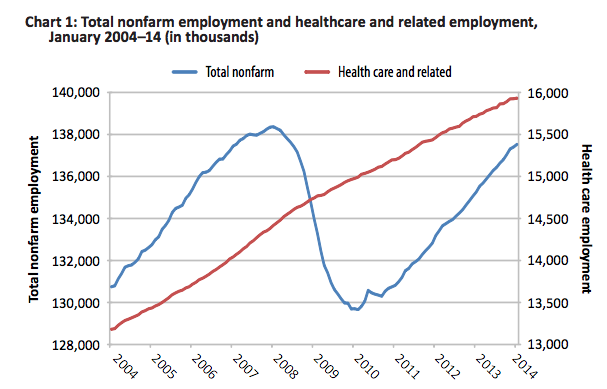
As a result, the healthcare industry will proceed to see increased demand for medical services—and medical personnel. Co-ordinate to the Agency of Labor Statistics, healthcare support occupations, healthcare practitioners, and technical occupations are expected to generate 2.3 million new jobs through 2024—faster employment growth than any other manufacture.
Healthcare administrators are already scrambling to fill jobs beyond a broad range of positions. In light of this high demand, credentialed healthcare professionals will be especially well positioned for career advancement.
An Online Health Sciences Degree — at Your Own Pace
Think y'all don't take time to earn a health sciences caste? Through the Academy of Wisconsin Flexible Option, you can earn a UW-Milwaukee Available of Science in Biomedical Sciences: Wellness Sciences in an online, cocky-paced format that fits whatever schedule. Equally a UW Flexible Choice student, you can kickoff any calendar month and larn at your ain pace—also as leverage your existing technical education and clinical experience to help you progress toward graduation more quickly.
Explore more virtually the UW Flexible Selection Available of Scientific discipline in Biomedical Sciences: Health Sciences.
- Curriculum
- Tuition
- Admissions
To be considered for admission to this program, yous must have completed an acquaintance degree.
Source: https://flex.wisconsin.edu/stories-news/what-can-you-do-with-a-health-sciences-degree/
0 Response to "What to Do With a Health Science Degree"
Post a Comment